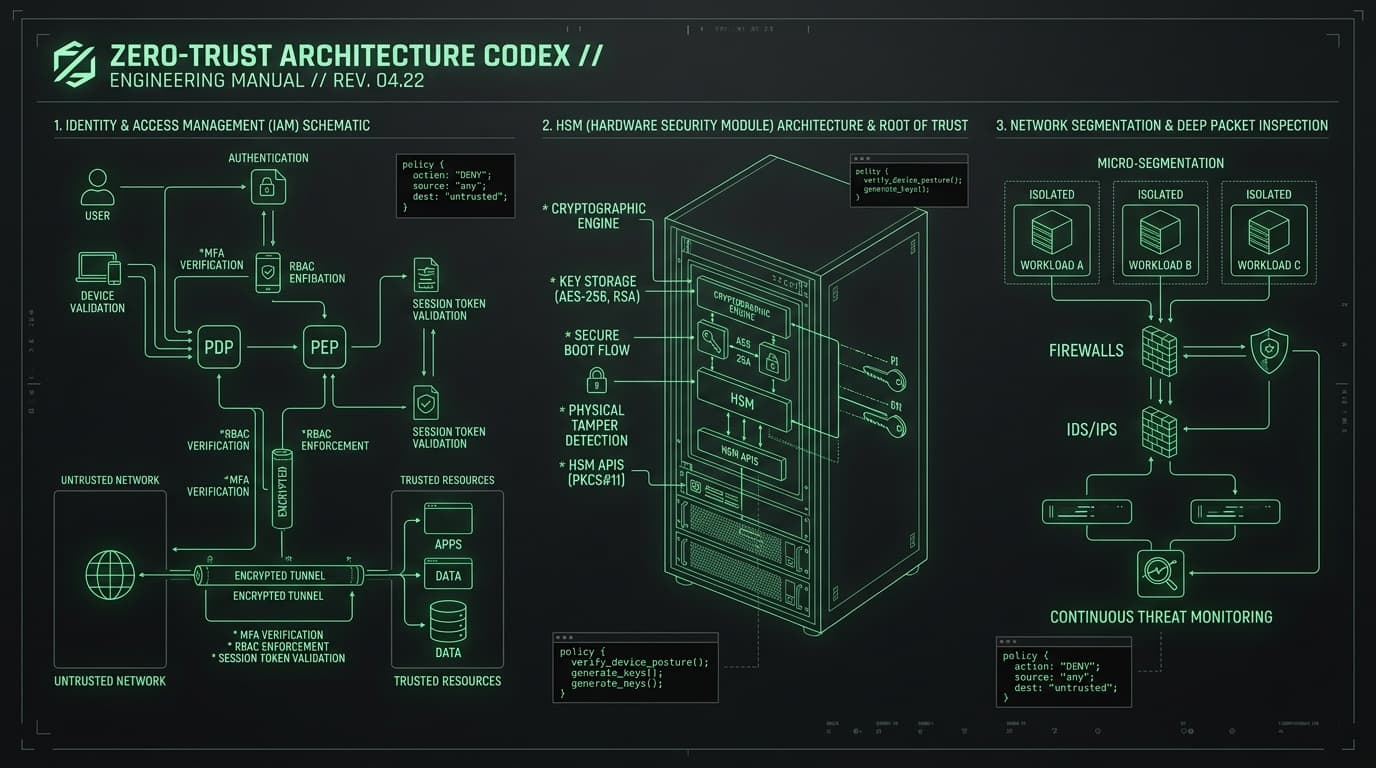
Securing Autonomous AI Agents: Zero-Trust Tool Sandboxing
Zero-Trust defense for generative AI systems. Defending against direct and indirect prompt injection, isolating LLM tool execution behind WebAssembly/MicroVM sandboxes, and enforcing strict cryptographic human approval gates.
Securing Autonomous AI Agents: Zero-Trust Tool Sandboxing
The Novel Attack Surface of Agentic AI
Autonomous AI agents equipped with external tools (code execution, database access, web scraping, email delivery) represent an entirely new class of untrusted computing workloads. Unlike deterministic code, Large Language Models are vulnerable to indirect prompt injection: an adversary embeds hidden malicious instructions inside an external document or webpage, hijacking the agent to execute privileged actions.
Zero-Trust Principles for AI Agents
- Never Trust Agent Intent: An LLM output is an untrusted user input, not an authenticated command.
- Deterministic Schema Enforcement: All tool arguments must pass strict schema validation (Zod, Pydantic) before execution.
- Micro-Sandboxing Untrusted Code: Arbitrary Python or JavaScript code generated by the agent must run inside ephemeral, network-isolated WebAssembly (WASM) or MicroVM (Firecracker) runtimes with memory limits.
- Cryptographic Human Approval Gate: Any high-stakes action (financial transactions, data deletion, credential modification) requires out-of-band cryptographic confirmation from a human supervisor.
[ Untrusted External Data ] ──> [ LLM Agent ]
                                      │
                         Tool Call Intent (Untrusted)
                                      │
                                      ▼
                       ┌─────────────────────────────┐
                       │    Zero-Trust Tool Proxy    │
                       │ - Schema Validation         │
                       │ - WASM / MicroVM Sandbox    │
                       │ - Human Approval Gatekeeper │
                       └──────────────┬──────────────┘
                                      │ Validated & Confirmed
                                      ▼
                             [ Enterprise API ]
Canonical Zero-Trust Defense per NIST SP 800-207 & CISA ZTMM 2.0: Eliminate static credentials, enforce eBPF microsegmentation, and preempt threats with in-kernel runtime telemetry.