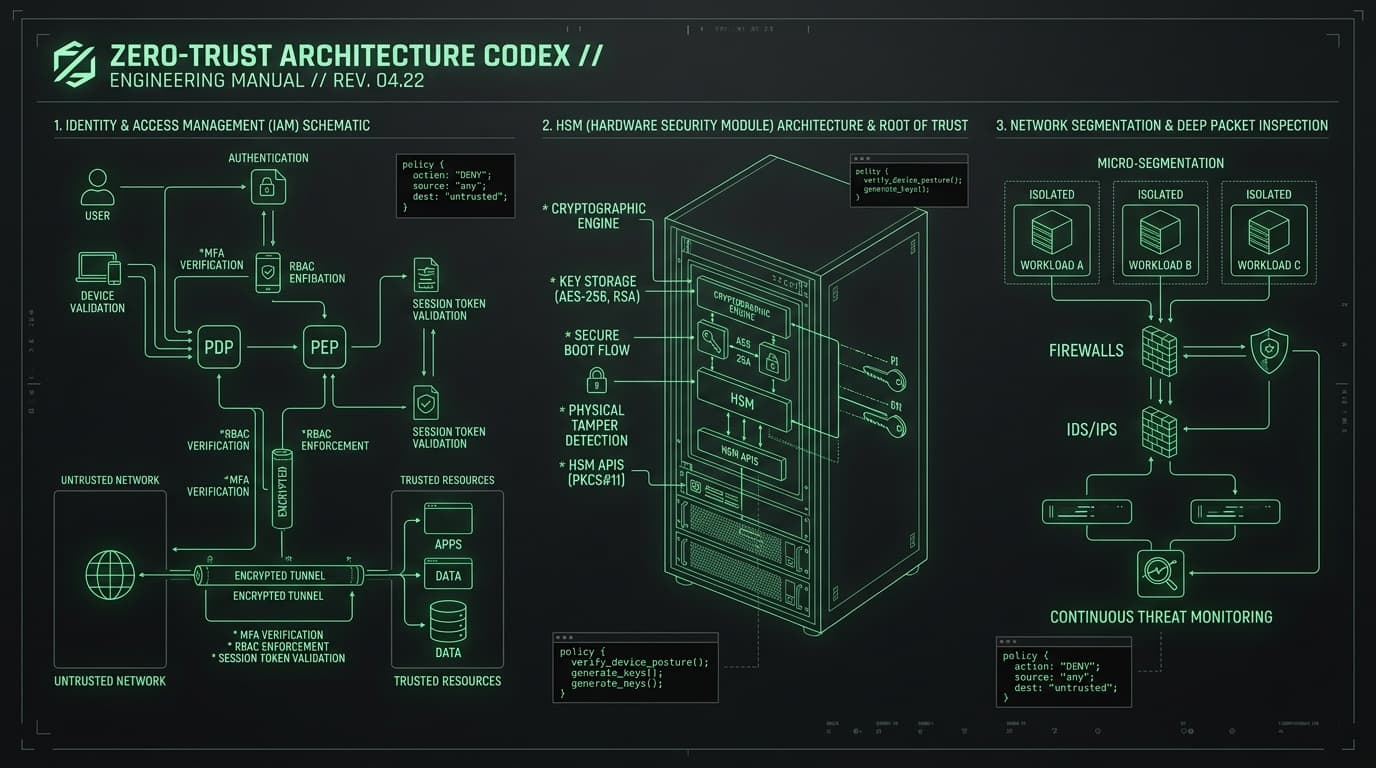
Zero-Trust Architecture Foundations & NIST SP 800-207
Deconstructing the fundamental transition from perimeter-based defense to Zero-Trust Architecture (ZTA). Detailed implementation of Policy Decision Points (PDP), Policy Enforcement Points (PEP), and the 7 NIST core tenets.
Zero-Trust Architecture Foundations & NIST SP 800-207
Executive Summary
Traditional enterprise security architectures relied on the "castle-and-moat" perimeter defense model: once an entity authenticated through the border firewall or corporate VPN, it gained implicit, unsegmented trust across internal networks. Zero-Trust Architecture (ZTA), codified in NIST Special Publication 800-207, systematically destroys this paradigm. Under ZTA, network locality grants zero trust; every request must be authenticated, authorized, and cryptographically verified based on continuous context.
The 7 Core Tenets of NIST SP 800-207
- All data sources and computing services are considered resources: There are no "safe" internal zones.
- All communication is secured regardless of network location: Inter-service RPC within a Kubernetes cluster requires the same cryptographic rigor as public internet ingress.
- Access to individual enterprise resources is granted on a per-session basis: Dynamic, short-lived sessions replace permanent authorizations.
- Access is determined by dynamic policy: Contextual signals include device health, geographic location, user role, and behavioral anomalies.
- The enterprise monitors and measures the integrity and security posture of all owned and associated assets: No device or container is automatically trusted.
- All resource authentication and authorization are dynamic and strictly enforced before access is allowed: Continuous evaluation replaces one-time login handshakes.
- The enterprise collects as much information as possible about the current state of assets, network infrastructure, and communications: Comprehensive telemetry feeds the Policy Engine.
The Policy Engine Architecture: PDP vs PEP
NIST SP 800-207 establishes a clean structural division of security responsibilities:
- Policy Decision Point (PDP):
- Policy Engine (PE): The brain responsible for deciding whether to grant access to a resource based on enterprise policy and external threat intelligence.
- Policy Administrator (PA): The control plane responsible for issuing and revoking communication credentials (e.g., short-lived tokens or mTLS certificates).
- Policy Enforcement Point (PEP): The gatekeeper (such as an Envoy sidecar proxy, API gateway, or in-kernel eBPF hook) that intercepts traffic and applies PDP decisions.
[ Subject / Workload ]
         │
         ▼  (Request)
 ┌───────────────┐        Decision Query        ┌─────────────────────────┐
 │      PEP      │ ───────────────────────────> │           PDP           │
 │ (Envoy / eBPF)│ <─────────────────────────── │ (Policy Engine + Admin) │
 └───────┬───────┘        Signed Grant          └─────────────────────────┘
         │ (Permitted Traffic)
         ▼
[ Enterprise Resource ]
Enterprise Migration Strategy: The 5-Phase Playbook
- Catalog Assets & Data Flows: Map all services, databases, and third-party APIs using automated eBPF network discovery.
- Deprecate Static Credentials: Replace static API keys with short-lived OIDC workload federation.
- Implement Identity-Aware Microsegmentation: Enforce default-deny network policies at Layer 7.
- Deploy Ephemeral Mutual TLS: Migrate to short-lived X.509 SVIDs managed by SPIFFE/SPIRE.
- Continuous Verification & Adversary Emulation: Execute automated breach and attack simulation against internal endpoints.
Canonical Zero-Trust Defense per NIST SP 800-207 & CISA ZTMM 2.0: Eliminate static credentials, enforce eBPF microsegmentation, and preempt threats with in-kernel runtime telemetry.