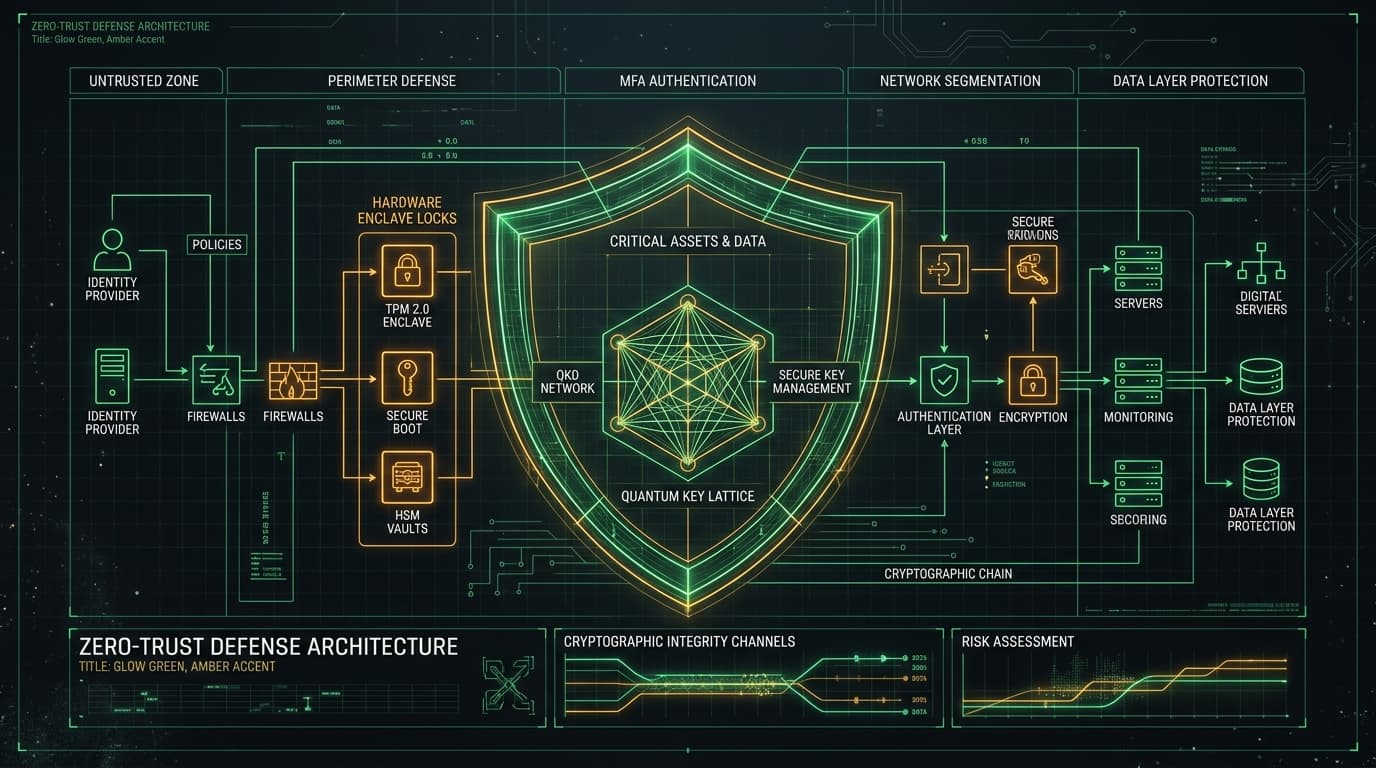
> ARCHITECTURE CANON // V1.0
Cybersecurity & Zero-Trust Canon
The Zero-Trust Architecture Bible: NIST SP 800-207, CISA ZTMM 2.0, eBPF & Cryptographic Workload Identity
Posture & Sizer Wizard
Evaluate CISA ZTMM 2.0 maturity; compute 3-tier hardening plan.
Architecture Catalog
SPIFFE/SPIRE, Cilium eBPF, and SLSA L3 across 54 maturity tiers.
Engineering Manuals
Deep runbooks for ephemeral PKI, eBPF runtime, and FIDO2 keys.
Comparison Matrix
Technical benchmark of Cilium, SPIRE, Vault, Tetragon, and Cosign.
18
54 Maturity Tiers24
MITRE & CVE / CWE10
Bilingual Runbooks22
eBPF, SPIFFE, FIDO2, PQCCISA ZTMM 2.0 5 Core Pillars & Cross-Cutting Capabilities
Zero Trust is not a product; it is an architectural discipline removing implicit trust across identity, devices, networks, workloads, and data.
Identity & Workload Authentication
Continuous cryptographic verification of human users and machine workloads with phishing-resistant FIDO2/WebAuthn, short-lived OIDC federation, and mutual TLS SPIFFE/SPIRE attestation.
Passwordless, ephemeral mTLS certificates (TTL < 1 hour), zero static long-lived credentials, hardware-bound security keys.
Devices & Endpoint Attestation
Hardware-rooted device health validation (TPM 2.0, Secure Boot, Secure Enclave), automated compliance telemetry, and dynamic quarantine of non-compliant hardware.
Continuous real-time posture validation, zero unmanaged bring-your-own-device (BYOD) access to sensitive data planes, automated micro-isolation.
Network Microsegmentation & eBPF
Elimination of flat network perimeters through kernel-level eBPF traffic policing, software-defined perimeters (SDP), encrypted peer-to-peer WireGuard overlays, and zero implicit trust.
Default-deny egress and ingress, eBPF-enforced Layer 7 identity routing, zero open internal subnets, micro-segmented workload perimeters.
Applications, Workloads & Supply Chain
Immutable container deployment, SLSA Level 3 cryptographic provenance, runtime system-call auditing via Tetragon, and fine-grained API authorization gateways.
Cosign/Sigstore verified image signatures, in-toto attestations, zero root privileges, read-only root filesystems, eBPF kernel enforcement.
Data Protection & Cryptographic Sovereignty
Envelope encryption with Bring Your Own Key (BYOK), field-level cryptographic tokens, automated classification, and Post-Quantum Cryptography (PQC) readiness.
Hardware Security Module (HSM) rooted envelope keys, confidential computing with AMD SEV-SNP/Intel SGX, quantum-resistant Kyber hybrid TLS.
Cross-Cutting Capabilities
- Visibility & Analytics: Unified distributed tracing, kernel-level eBPF telemetry, and continuous behavioral anomaly detection across all five pillars.
- Automation & Orchestration: Automated policy enforcement, dynamic secret rotation, automated quarantine of compromised nodes, and ephemeral runtime lifecycle.
- Governance & Policy-as-Code: Continuous compliance auditing, Open Policy Agent (OPA) gatekeepers, and statutory adherence to NIST SP 800-207 and SOC 2 Type II.
24 Critical Threat Typologies & Attack Vectors
CVE/CWE mappings, MITRE ATT&CK techniques, eBPF Tetragon/Falco detection queries, and CLI playbooks.
Long-Lived Static Cloud IAM Access Key Leakage
Hardcoded or committed long-lived AWS_ACCESS_KEY_ID or GCP Service Account JSON keys leaked into source code repositories, CI logs, or developer machines.
eventSource: "signin.amazonaws.com" AND eventName: "ConsoleLogin" AND responseElements.ConsoleLogin: "Success" AND NOT userIdentity.sessionContext.sessionIssuer.type: "Role"
Golden SAML & Forged Token Impersonation
Adversary compromises Active Directory Federation Services (AD FS) private signing keys, generating arbitrary SAML tokens that bypass multi-factor authentication (MFA).
EventID: 4624 AND LogonType: 3 AND AuthenticationPackageName: "Negotiate" AND TargetUserName: "Administrator" AND FailureReason: "None"
Kubernetes Service Account Token Theft
Compromised container reads the default mounted projected volume `/var/run/secrets/kubernetes.io/serviceaccount/token`, enabling lateral API server queries.
k8s.audit.requestURI: "/api/v1/namespaces/kube-system/secrets" AND k8s.audit.responseStatus.code: 200 AND NOT user.username: "system:node:*"
Reverse-Proxy Phishing & Session Hijacking
Adversary deploys evilginx2 reverse proxy to intercept credentials and session cookies during login, bypassing standard SMS, TOTP, and Push-based MFA.
http.request.headers.referer NOT MATCHES "https://*.tinycto.tv" AND http.response.cookies.name CONTAINS "session_id"
Overprivileged Microservice Lateral Movement
Compromised frontend service communicates freely with internal payment or user databases due to an unsegmented, flat VPC network design.
cilium_drop_count{reason="PolicyDenied"} > 0 OR (src_workload="frontend" AND dst_workload="payment-db" AND dst_port=5432)Flat VPC Egress Data Exfiltration via Public S3
Compromised compute node uploads sensitive proprietary database dumps to an attacker-controlled external AWS S3 bucket over unrestricted egress 0.0.0.0/0.
flow_log.dst_port: 443 AND flow_log.dst_bytes > 100000000 AND flow_log.vpc_id: "vpc-prod" AND NOT flow_log.dst_vpc_endpoint: "vpce-s3"
Canonical Zero-Trust Defense per NIST SP 800-207 & CISA ZTMM 2.0: Eliminate static credentials, enforce eBPF microsegmentation, and preempt threats with in-kernel runtime telemetry.
Frequently Asked Questions
What is the core philosophical difference between traditional perimeter defense and Zero-Trust Architecture (ZTA)?
Traditional perimeter security relies on the "castle-and-moat" paradigm: once a user or machine crosses the network boundary (e.g. via VPN), they are implicitly trusted with wide lateral network access. Zero-Trust Architecture (NIST SP 800-207) asserts "Never Trust, Always Verify, Assume Breach". Every request—whether originating from outside the organization or inside a private Kubernetes cluster—must be dynamically authenticated, authorized, and cryptographically verified based on contextual signals.
How does NIST SP 800-207 define Policy Decision Points (PDP) and Policy Enforcement Points (PEP)?
Under NIST SP 800-207, the Policy Decision Point (PDP) is the logical brain comprising the Policy Engine (which evaluates continuous enterprise access rules) and the Policy Administrator (which issues or revokes access credentials). The Policy Enforcement Point (PEP) is the gatekeeper (e.g. an Envoy proxy, API gateway, or eBPF kernel hook) that intercepts traffic and strictly permits or terminates connections as instructed by the PDP.
Why are static long-lived credentials (API keys, passwords) considered a critical Zero-Trust anti-pattern?
Static credentials lack contextual temporal binding. Once leaked (via GitHub commit, compromised developer workstation, or CI log), an attacker can exploit them indefinitely from any location without triggering traditional perimeter alarms. Modern Zero-Trust mandates ephemeral credentials (TTL < 1 hour) issued via short-lived OpenID Connect (OIDC) federation, SPIFFE/SPIRE mutual TLS certificates, or hardware-bound FIDO2/WebAuthn passkeys.
How does kernel-level eBPF (Cilium/Tetragon) improve upon legacy iptables for microsegmentation?
Legacy iptables scales linearly O(N), causing severe CPU overhead and latency degradation when clusters scale to thousands of pods and network rules. Furthermore, iptables operates blindly on IP addresses and ports without application context. Cilium eBPF replaces iptables with in-kernel BPF hash maps operating in constant O(1) time, enabling cryptographic identity-based filtering, L7 protocol inspection (HTTP/gRPC/Kafka), and automated in-kernel process termination (SIGKILL) without user-space context switches.
What is SPIFFE/SPIRE and how does it establish workload attestation without secrets?
SPIFFE (Secure Production Identity Framework for Everyone) is a CNCF open standard defining uniform, cryptographic identity strings (SPIFFE IDs) for workloads. SPIRE is its reference implementation. A local SPIRE Agent inspects the Linux kernel (/proc) and container runtime to attest workload attributes (container image SHA, namespace, service account) without the workload ever possessing a private key. It dynamically injects an ephemeral X.509 SVID into the workload's memory via the SPIFFE Workload API.
What is SLSA Level 3 and why is keyless signing via Sigstore Cosign critical for software supply chains?
SLSA (Supply-chain Levels for Software Artifacts) Level 3 certifies that source code was built in an isolated, hermetic, and verifiable build platform where intermediate inputs cannot be tampered with. Sigstore Cosign keyless signing uses short-lived OpenID Connect tokens from the CI runner (GitHub Actions / GitLab CI) and Fulcio Certificate Authority to sign artifacts, recording the cryptographic proof permanently in the public Rekor transparency log without developers needing to manage or store private keys.
How does envelope encryption with Customer Managed Keys (CMK) and BYOK prevent insider cloud threats?
In envelope encryption, plaintext data is encrypted locally using a unique, ephemeral Data Encryption Key (DEK). The DEK is then encrypted under a Master Key (KEK) managed in a dedicated Hardware Security Module (HSM). Under Bring Your Own Key (BYOK), the customer controls the HSM master key policy. Even if a rogue cloud provider administrator or compromised tenant process gains raw disk snapshots or database dumps, the data remains cryptographically unintelligible without access to the customer-controlled HSM.
How does Post-Quantum Cryptography (PQC) protect against "Harvest Now, Decrypt Later" adversaries?
Hostile nation-states and sophisticated adversaries are actively recording and storing high-value encrypted enterprise internet traffic today, anticipating the arrival of Cryptanalytically Relevant Quantum Computers (CRQCs) that will break RSA-2048 and ECC via Shor's algorithm. Post-Quantum Cryptography (NIST FIPS 203 ML-KEM / Kyber-768) relies on lattice-based mathematics that quantum computers cannot solve in polynomial time. Deploying hybrid TLS 1.3 (X25519 + ML-KEM) immediately eliminates this vulnerability.
What unique Zero-Trust challenges arise from autonomous AI agents and tool-calling LLMs?
Autonomous agents blur the boundary between untrusted user input and executable code. Indirect prompt injection attacks embed concealed directives in data (web pages, PDFs, emails) that hijack the LLM to execute destructive tool calls (e.g. database deletion, funds transfer). A Zero-Trust posture treats the LLM itself as an untrusted computation engine: tool calls must pass through a strict authorization proxy with parameter schema validation, execution must run in air-gapped MicroVM/WASM sandboxes, and state-mutating actions mandate cryptographic Human-in-the-Loop approval.
How does CISA Zero Trust Maturity Model 2.0 measure organizational progress across its five pillars?
CISA ZTMM 2.0 categorizes progress across 4 maturity stages: Traditional (manual configurations, static perimeter firewalls, password auth), Initial (basic SSO, siloed MFA, lifecycle scripts), Advanced (cross-pillar policy coordination, centralized identity, automated device health, microsegmentation), and Optimal (fully automated dynamic policy decision points, ephemeral cryptographic workloads, machine-speed orchestration, continuous behavioral visibility).
Why is Software-Defined Perimeter (SDP) Single Packet Authorization (SPA) superior to traditional VPN ports?
Traditional corporate VPN gateways (OpenVPN, IPsec) leave public internet ports open (e.g. 443, 1194, 500) that are readily discoverable by mass internet scanners (Shodan, Censys), exposing zero-day buffer overflows or authentication bypasses. Single Packet Authorization (SPA) keeps firewall ports completely dark (drop 100%). A client must transmit an encrypted, HMAC-authenticated single packet that dynamically opens a temporary firewall pinhole for only that specific source IP for a matter of seconds to complete the handshake.
How does Continuous Breach & Attack Simulation (BAS) prove Zero-Trust efficacy in live production?
Annual penetration tests represent a point-in-time assessment that rapidly drifts as engineering teams continuously push code, update Kubernetes manifests, and modify cloud security groups. Continuous Breach & Attack Simulation (e.g. Stratus Red Team, Atomic Red Team) programmatically detonates synthetic, non-destructive MITRE ATT&CK techniques in production, asserting mathematically that alerts trigger in the SIEM, eBPF Tetragon policies kill processes, and network microsegmentation drops lateral packets.