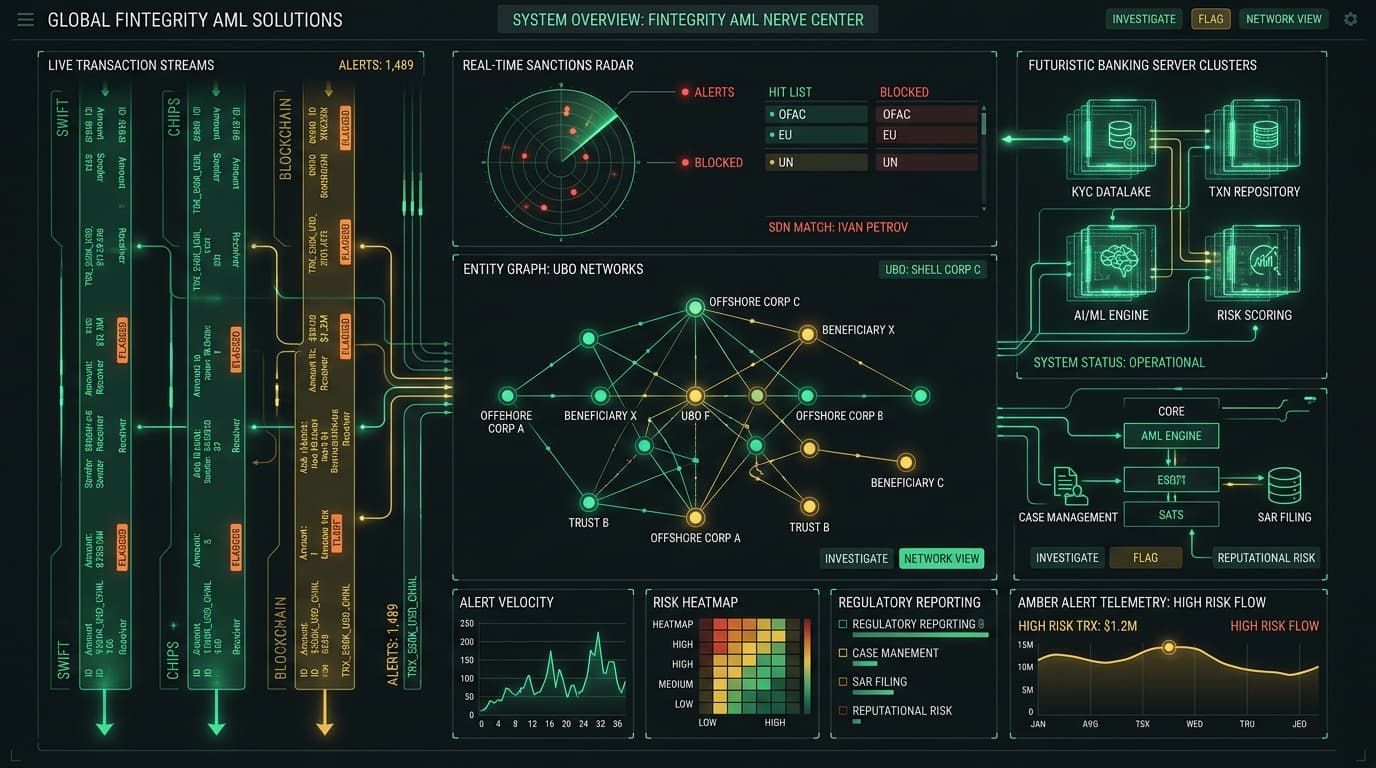
> FINANCIAL_INTEGRITY_v1.0
Financial Integrity, AML & Crime Prevention Canon
The authoritative engineering canon for financial crime prevention, anti-money laundering (AML/CFT/CPF), sanctions screening, and compliance architectures: 12 reference architectures, 38 runtime skills, and deterministic wizard.
Architecture Wizard
Deterministic sizing
12 Architectures
36 maturity targets
8 Manuals
Bilingual deep guides
Comparison Matrix
Latency, TPS & TCO
Core Architectural Pillars
Four defense-in-depth layers of modern financial integrity
1. Real-Time Streaming Monitoring
Kafka + Flink CEPEliminates legacy T+1 overnight batch blindness, evaluating rolling sliding windows to intercept cash structuring and rapid transit flows in sub-second latency.
2. Multilingual Sanctions Screening
Phonetic Transliteration <30msScreens Cyrillic, Arabic, and Chinese transliterations via cultural tokenization and phonetic distance metrics, guaranteeing pre-authorization blocking with zero false suppression.
3. UBO & Graph Network Analytics
Multi-Degree Graph TraversalUnwraps multi-layered offshore holding companies and trusts via recursive path multiplication, discovering natural beneficial owners exceeding 25% or 10% statutory thresholds.
4. Air-Gapped Anti-Tipping-Off Vault
Zero-Knowledge HSM EncryptionIsolates Suspicious Transaction Reports (STR/SAR) and investigation dossiers completely from core banking CRMs, physically preventing criminal tipping-off breaches.
The TinyCTO Financial Integrity, AML & Crime Prevention Canon is an authoritative, defensive compliance architecture uniting sub-second streaming transaction monitoring (Apache Kafka/Flink), multilingual phonetic sanctions screening (<30ms SLA), recursive ultimate beneficial ownership (UBO) graph unwrapping, and air-gapped anti-tipping-off investigation vaults. Fully governed under Federal Reserve SR 11-7 and EU AI Act mandates.
Frequently Asked Questions
Why is real-time streaming transaction monitoring mandatory instead of traditional overnight batch processing?
Traditional T+1 or T+2 overnight batch processing introduces an unacceptable window of vulnerability. In modern high-velocity payment rails (such as instant SEPA, FAST, FedNow, or crypto rails), illicit funds are deposited, layered, and withdrawn within minutes. Sub-second streaming monitoring using Apache Kafka and Apache Flink evaluates stateful sliding windows to hold suspicious funds in transient settlement buffers before irreversible value dissipation occurs.
How does the Ultimate Beneficial Ownership (UBO) unwrapping algorithm handle multi-jurisdictional holding structures?
The UBO graph unwrapping engine models corporate shareholding as a directed acyclic graph (DAG). It recursively traces ownership percentages across intermediate corporate vehicles, holding entities, and trusts, multiplying equity stakes across each directed edge. Any natural person whose cumulative indirect stake equals or exceeds 25% (or 10% for high-risk corporate entities) is automatically identified as an Ultimate Beneficial Owner in accordance with FATF Recommendations 24 and 25 and EU 6AMLD standards.
What are the strict anti-tipping-off requirements governing Suspicious Transaction Reports (STR/SAR)?
Under FATF Recommendation 21 and national statutes (such as MASAK Law No. 5549 Article 4 and UK POCA Section 333A), informing an account holder or any unauthorized third party that an STR/SAR has been filed or that an AML investigation is underway constitutes a serious criminal offense. To enforce this physically, compliance architectures utilize air-gapped zero-knowledge vaults that isolate investigation dossiers from core banking CRMs, ensuring customer service agents only see neutral operational statuses.
How do phonetic and fuzzy matching engines prevent sanctions screening false suppression in non-Latin scripts?
Sanctions evasion networks deliberately exploit inconsistent transliterations of Cyrillic, Arabic, Chinese, and Farsi names. The sanctions screening pipeline deploys cultural name tokenizers, removes corporate suffixes, and applies multi-pass phonetic algorithms (such as Double Metaphone and Beider-Morse Phonetic Matching) combined with token-order insensitive Levenshtein and Jaro-Winkler distance scoring. This ensures that non-Latin script permutations match designated targets with high recall without choking operations with false positives.
How does the Travel Rule function across Virtual Asset Service Providers (VASPs)?
Under FATF Recommendation 16 and the EU Transfer of Funds Regulation (TFR), VASPs executing crypto transfers exceeding statutory thresholds ($1,000 / €1,000) must transmit verified originator and beneficiary identity data to counterparty institutions. VASPs utilize cryptographic federated networks (such as TRISA and OpenVASP) exchanging IVMS 101 data payloads over mutual-TLS. Funds are quarantined in settlement buffers until counterparty VASP identity and wallet address ownership are cryptographically validated.
How do Explainable AI (XAI) and demographic parity safeguards protect consumers from arbitrary de-banking?
Indiscriminate, unexplainable machine learning scores can result in discriminatory de-risking against legitimate diaspora communities or charities. Under the EU AI Act (Article 13) and Federal Reserve SR 11-7, compliance models must provide local SHAP feature attributions explaining the exact mathematical factors driving an alert. Furthermore, unilateral automated account closures are strictly prohibited; every termination requires certified human review, regular adverse impact ratio (AIR) testing, and an accessible 5-day contestability appeals channel for customers.