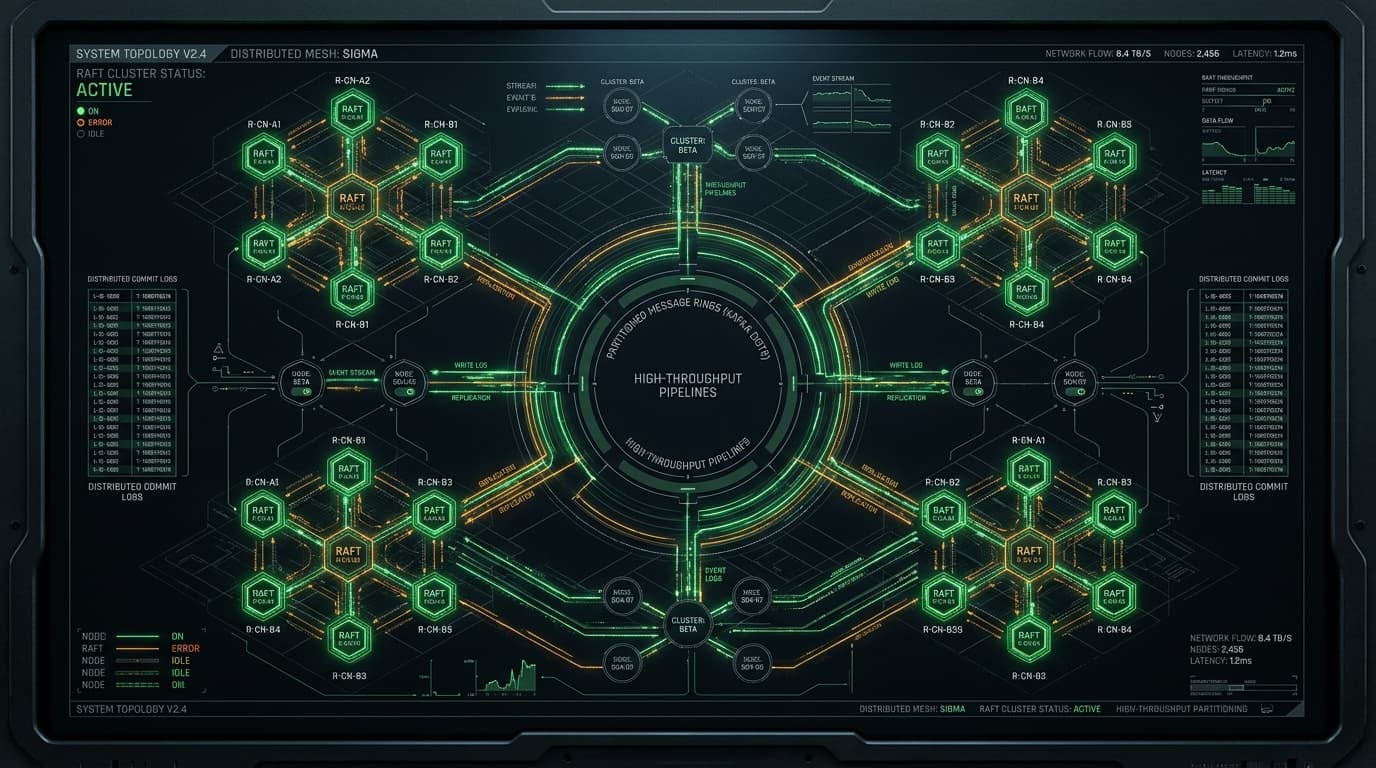
> CANON #06 // DISTRIBUTED SYSTEMS & EVENT-DRIVEN
High-Throughput Distributed Systems & Event-Driven Architecture
The authoritative engineering canon for log-centric streaming, consensus state machines, transactional outbox CDC, and reactive backpressure under CAP & PACELC proofs.
Calculate partitions, ingress, and cluster nodes
54 maturity tiers with Terraform & K8s configs
Deep theory on CAP, Raft, Kafka, Outbox & CRDTs
Compare Kafka, Redpanda, Temporal, ScyllaDB
High-Throughput Distributed Systems & Event-Driven Architecture Canon per CAP, PACELC, Raft, and Reactive Streams: Eliminate dual-write drift with Transactional Outbox, block zombie leaders with fencing tokens, and prevent OOM collapses with pull backpressure.
The 6 Foundational Distributed Pillars
Structural pillars governing CAP & PACELC trade-offs, eliminating data loss and cascading degradation.
Log-Centric Event Streaming & Partitioning
High-throughput, append-only, sequentially written distributed commit logs that decouple event producers from consumers with zero-copy I/O and deterministic partitioning.
Consensus & State Machine Replication
Deterministic agreement protocols among distributed nodes under crash-fault network conditions ensuring leader election, term validation, and linearizable write operations.
Event Sourcing & Command-Query Responsibility Segregation
Modeling state changes as an immutable sequence of domain events (Append-Only Event Store) while physically separating write mutations from query-optimized read projections.
Transactional Outbox & Saga Orchestration
Guaranteeing atomic state mutations and outbound event emission across microservice boundaries via database transaction logs (CDC) and compensable workflow sagas.
Consistent Hashing, Sharding & Multi-Master CRDTs
Horizontally partitioning massive datasets across dynamic cluster topologies with consistent hash rings, tunable replica quorums, and mathematically conflict-free replication.
Reactive Flow Control, Circuit Breakers & Shed-Load Protection
Defending distributed systems against cascading queue exhaustion, consumer lag spirals, and catastrophic degradation via pull-based reactive flow, token-bucket rate limits, and hedge requests.
24 Production Failure Patterns & Mitigations
Detection PromQL queries and mitigation runbooks for split-brain, dual-write drift, and rebalance storms.
Split-Brain Partitioning & Divergent Quorums
Network partition divides an un-fenced cluster into two disjoint sub-clusters, each erroneously believing it maintains a majority quorum and accepting contradictory mutations.
sum by (cluster) (rate(etcd_server_leader_changes_seen_total[2m])) > 2 or count(raft_is_leader == 1) > 1Dual-Write Mutation Drift & Distributed Desynchronization
Application writes state to a relational database and then publishes an event to Kafka. If either step fails or crashes mid-way, database state diverges permanently from event log.
abs(sum(rate(db_orders_created_total[5m])) - sum(rate(kafka_topic_orders_messages_in_total[5m]))) > 0.05Unbounded Consumer Lag Spiral & Broker Disk Saturation
Downstream consumer processing times degrade, causing unconsumed messages to accumulate on brokers. Consumer lag escalates exponentially until broker disks hit 100% or log segments truncate.
sum by (topic, group) (kafka_consumergroup_lag) > 50000 and rate(kafka_consumergroup_lag[5m]) > 0Poison Pill Serialization & Consumer Group Deadlock
A malformed payload or unhandled runtime deserialization exception causes the consumer to throw an unhandled error, crash, and restart at the exact same offset repeatedly.
sum by (consumer_group) (rate(kafka_consumer_failures_total[2m])) > 10 and delta(kafka_consumer_offset[5m]) == 0Rebalance Storm Cascade Under Slow Heartbeats
Consumers exceed `max.poll.interval.ms` while processing heavy workloads. The group coordinator assumes the consumer died, kicking it and triggering a cluster-wide partition rebalance storm.
rate(kafka_server_GroupCoordinator_RebalancesTotal[2m]) > 0.5Distributed Deadlock & Saga Compensation Starvation
A choreography-based saga encounters a failure at step 4 of 6, but the compensating transaction for step 2 fails due to a network partition, leaving external bank accounts or inventories reserved indefinitely.
sum(temporal_workflow_failed_total{workflow_type="OrderFulfillmentSaga"}) > 0Technical Frequently Asked Questions
Deep architectural clarifications on linearizability, outbox CDC, Raft consensus, and reactive streams.
Technical Frequently Asked Questions
What is the fundamental mathematical difference between Linearizability and Serializability?
Serializability is a multi-operation, multi-object transactional property: it guarantees that a group of transactions executing concurrently appears to have executed in some valid sequential serial order, but says nothing about real-time wall-clock ordering. Linearizability (atomic consistency) is a single-operation, single-object real-time guarantee: once an operation completes in real physical time, all subsequent operations globally must observe that new value or a newer one. A system providing both guarantees simultaneously is termed "Strict Serializable" or "External Consistent" (e.g. Google Cloud Spanner).
How does the Transactional Outbox pattern mathematically eliminate dual-write mutation drift?
The naive dual-write anti-pattern attempts to execute an RDBMS mutation and publish to Kafka sequentially in application code. If either operation fails, times out, or the process crashes mid-flight, state diverges permanently. The Transactional Outbox pattern stores the outbound event inside a dedicated `outbox_events` table within the EXACT SAME local database transaction as the business entity. Atomicity is guaranteed by local RDBMS ACID properties. A separate Change Data Capture (CDC) engine (such as Debezium) tails the database Write-Ahead Log (WAL) and streams the events to Kafka with guaranteed at-least-once ordered delivery.
When should an architecture select Apache Kafka over RabbitMQ or NATS JetStream?
Select Apache Kafka when you need a persistent, append-only replayable commit log, high aggregate partition throughput (>100k msg/sec), long-term retention (days/weeks/infinite via tiered storage), consumer group replayability, and strict total ordering per partition key. Select RabbitMQ when you need complex AMQP dynamic routing topologies, granular worker queue competition, selective message acknowledgment, and priority queuing. Select NATS JetStream when you need ultra-low-latency (<1ms), lightweight operational footprints (single binary), zero JVM overhead, and decentralized edge or IoT pub/sub.
How does Raft achieve consensus and strictly prevent split-brain during network partitions?
Raft guarantees safety through quorum majorities ($Q = \lfloor N/2 \rfloor + 1$). In an odd-numbered cluster (e.g. 5 nodes), any two majorities of 3 nodes MUST overlap in at least one node. If a network partition splits the cluster into 3 nodes and 2 nodes, only the 3-node partition can gather a majority to elect a leader and commit log entries. The 2-node sub-cluster cannot achieve a quorum ($2 < 3$) and rejects all client writes. Furthermore, monotonic term numbers ensure that any stale leader from a lower term is immediately stepped down when contacting a node with a higher term.
Why does Saga Orchestration scale more reliably than Saga Choreography in production?
In Saga Choreography, microservices listen to domain events and autonomously decide to publish follow-up events or execute compensations. As workflows expand past 4 services, choreography creates invisible cyclic event loops, tangled distributed state, impossible forensic observability, and compensation starvation when edge services fail. Saga Orchestration (using Temporal.io or Cadence) centralizes workflow coordination into a durable state machine: the orchestrator explicitly commands participants, tracks timeouts, executes compensating transactions deterministically on failure, and persists execution history across node crashes.
How do Conflict-Free Replicated Data Types (CRDTs) achieve multi-master convergence without locks?
CRDTs rely on abstract algebra: mutations are structured as join-semilattices equipped with a merge operator ($\sqcup$) that satisfies three mathematical properties: Commutativity ($A \sqcup B = B \sqcup A$), Associativity ($(A \sqcup B) \sqcup C = A \sqcup (B \sqcup C)$), and Idempotence ($A \sqcup A = A$). Because the order and frequency of applying state updates do not change the final merged result, multi-region replicas can accept write mutations locally with zero coordination latency, exchange updates asynchronously, and guarantee mathematical convergence to the exact same state once all updates are observed.
How do Hybrid Logical Clocks (HLC) and TrueClock solve physical clock drift in distributed databases?
Physical system wall-clocks drift due to NTP latency, temperature changes, and hardware crystal defects. Relying on physical timestamps for Last-Write-Wins (LWW) silently destroys updates. Google TrueClock solves this using atomic clocks and GPS receivers in each datacenter, bounding physical clock uncertainty to a narrow window ($epsilon \approx 1-7ms$) and enforcing a "commit wait" delay so transactions are guaranteed causal ordering. Hybrid Logical Clocks (HLC) combine physical wall-clock time with Lamport logical counters in a 64-bit integer: the physical component tracks real time while the logical component increments whenever causal events occur within the same millisecond.
What are the catastrophic failure modes of naive distributed locks implemented with Redis SETNX?
Naive distributed locks (`SET resource_id token NX PX 10000`) fail under real-world conditions: 1. If a client acquires the lock and experiences an unannounced JVM Garbage Collection pause or thread stall exceeding the TTL (e.g. 15s), Redis automatically releases the lock. 2. A second client acquires the lock. 3. The first client awakens from its pause, assumes it still owns the lock, and executes a write to shared storage simultaneously with Client 2, corrupting state. Martin Kleppmann proved that distributed locks MUST provide strictly increasing monotonic fencing tokens validated at the storage layer to prevent zombie writes.
Why do push-based event streams trigger OOM crashes, and how does pull-based backpressure solve it?
In push-based streaming, producers push data as fast as they can write. If downstream consumer processing slows (due to database latency or external APIs), unconsumed messages accumulate in memory buffers. Memory usage grows monotonically until the operating system Linux OOM killer abruptly terminates the container. Reactive Streams (RSocket, Project Reactor) inverts flow control to pull-based backpressure: the subscriber explicitly requests only the number of items it has capacity to process (`request(n)`). The upstream publisher is physically prohibited from sending more items until the subscriber signals demand.
How does Kafka KRaft eliminate ZooKeeper while ensuring partition metadata integrity?
In legacy Kafka, ZooKeeper maintained cluster metadata externally, requiring dual-controller state synchronization and causing multi-minute failover pauses when clusters held millions of partition states. Kafka Raft (KRaft - KIP-500) brings metadata management directly inside Kafka itself using an internal replicated Raft event log (`@metadata`). A dedicated quorum of KRaft controller nodes maintains the metadata log in memory and snapshots it to disk. Failover is instantaneous (<500ms) because new leaders already have the full metadata log replicated in RAM, enabling Kafka clusters to scale to tens of millions of partitions.
What is the precise architectural difference between At-Least-Once and Effectively-Once semantics?
At-Least-Once delivery guarantees that no event is lost, but network retries and consumer restarts may cause identical records to be delivered and processed multiple times. Physical "True Exactly-Once" delivery across arbitrary uncoordinated distributed boundaries is mathematically impossible across unreliable networks (the Two Generals Problem). What systems achieve in practice is "Effectively-Once" (or Transactional Exactly-Once): producers use idempotent sequence IDs, the broker deduplicates retries within a transaction coordinator session, and consumers either apply idempotent mutation handlers or use unique constraints to discard duplicates.
How should enterprise engineering teams implement Chaos Engineering and Jepsen verification for distributed clusters?
Enterprise teams should adopt a continuous fault injection lifecycle: 1. Deploy Chaos Mesh or LitmusChaos in staging environments to inject asymmetric network partitions, 100ms packet delays, and random process SIGKILLs. 2. Write client test harnesses executing concurrent read and write operations against the cluster under chaos. 3. Record all execution histories (timestamps, thread IDs, inputs, and outputs). 4. Feed the execution histories into Jepsen linearizability checkers like Knossos or Porcupine to mathematically prove that no stale reads, dirty writes, or lost updates occurred during network partitions.