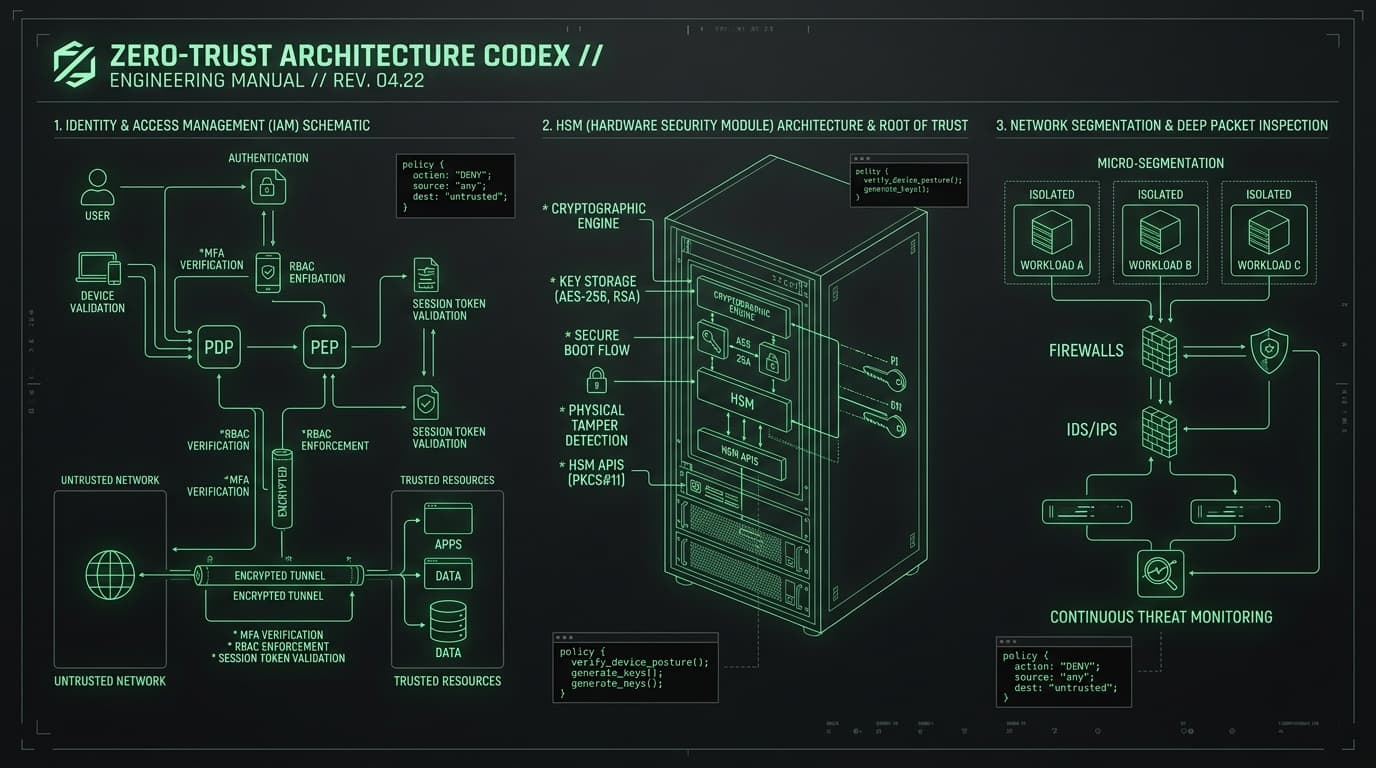
Continuous Adversarial Verification & Breach Simulation (BAS)
Proving Zero-Trust posture mathematically through automated breach and attack simulation (BAS), canary credential deployment, deception honeypots, and production chaos security experiments.
Continuous Adversarial Verification & Breach Simulation (BAS)
Moving Beyond Annual Penetration Tests
Traditional annual penetration tests produce static reports that become obsolete the moment a new container is deployed or an infrastructure change is applied. Zero-Trust requires continuous verification: proving security assumptions mathematically in production every hour.
Breach & Attack Simulation (BAS)
BAS platforms continuously execute automated, non-destructive adversary emulation techniques mapped to the MITRE ATT&CK enterprise matrix:
- Validating whether an unsegmented pod can reach the internal payment database.
- Attempting to query the AWS metadata service (
169.254.169.254) from an unprivileged pod. - Testing whether Canary Tokens trigger instantaneous high-fidelity alerts.
Cyber Deception: Honeypots & Decoy Credentials
By planting fake secrets (Canary Tokens, decoy AWS access keys, honeypot Kubernetes pods), security teams invert the asymmetric advantage of the attacker. Any interaction with a decoy asset is a guaranteed true-positive indicator of compromise (IoC), triggering automated network isolation via Cilium eBPF within milliseconds.
[ Adversary Intruding Pod ]
           │
           ▼  (Queries Decoy AWS Key)
  ┌─────────────────┐        High-Fidelity Alert        ┌─────────────────────────┐
  │ Canary Token DB │ ────────────────────────────────> │ Security Control Plane  │
  └─────────────────┘                                   └───────────┬─────────────┘
                                                                    │
                                                 Instant eBPF Kill & Quarantine
                                                                    │
                                                                    ▼
                                                        [ Compromised Pod Halted ]
Canonical Zero-Trust Defense per NIST SP 800-207 & CISA ZTMM 2.0: Eliminate static credentials, enforce eBPF microsegmentation, and preempt threats with in-kernel runtime telemetry.