> ARCHITECTURE CATALOG // V1.0
18 Zero-Trust Reference Architectures
54 Maturity Tiers, Hardware Root of Trust, Kernel eBPF Enforcement & Post-Quantum Cryptography
Hardware HSM Envelope Encryption & BYOK Data Vault
Multi-layered envelope encryption architecture utilizing dedicated FIPS 140-3 Level 3 Hardware Security Modules (HSM), generating ephemeral data encryption keys (DEK) for database columns and files.
Adversary gains raw database dump or storage volume snapshot, attempting offline cryptanalysis to read sensitive customer data.
Post-Quantum Cryptography Hybrid TLS 1.3 Key Exchange
Quantum-resistant cryptographic transition architecture implementing NIST-standardized Post-Quantum Cryptography (PQC) hybrid key encapsulation (X25519 + ML-KEM / Kyber-768), defeating "Harvest Now, Decrypt Later" adversaries.
State-sponsored adversary records encrypted network traffic today, intending to decrypt confidential communications using future quantum computers.
Confidential Computing with AMD SEV-SNP Memory Encryption
Zero-Trust hardware enclave architecture utilizing AMD SEV-SNP and Intel TDX, encrypting virtual machine memory in-use to protect cryptographic keys and proprietary models from hypervisor and cloud provider access.
Rogue cloud provider administrator or compromised hypervisor process inspects RAM memory to extract TLS private keys or proprietary LLM weights.
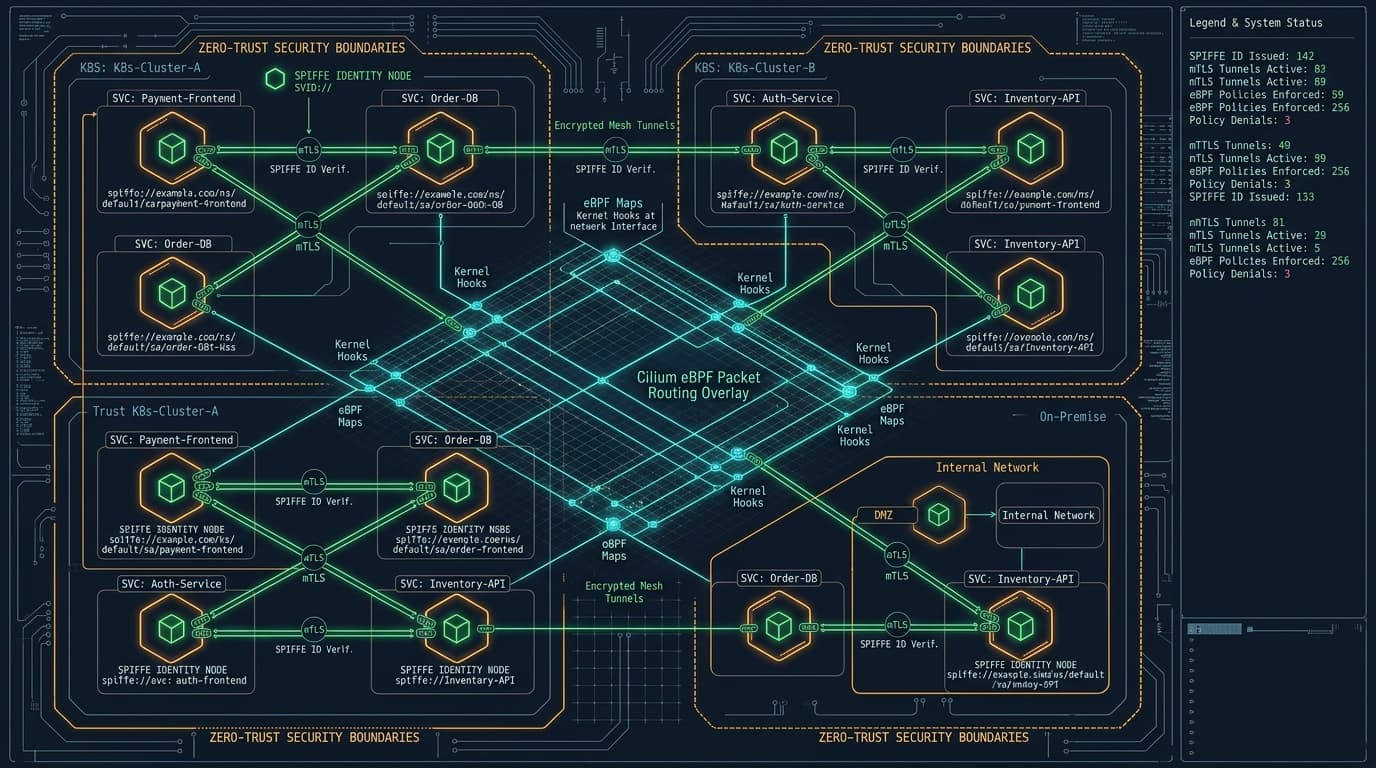
Canonical Zero-Trust Defense per NIST SP 800-207 & CISA ZTMM 2.0: Eliminate static credentials, enforce eBPF microsegmentation, and preempt threats with in-kernel runtime telemetry.
Frequently Asked Questions
What is the core philosophical difference between traditional perimeter defense and Zero-Trust Architecture (ZTA)?
Traditional perimeter security relies on the "castle-and-moat" paradigm: once a user or machine crosses the network boundary (e.g. via VPN), they are implicitly trusted with wide lateral network access. Zero-Trust Architecture (NIST SP 800-207) asserts "Never Trust, Always Verify, Assume Breach". Every request—whether originating from outside the organization or inside a private Kubernetes cluster—must be dynamically authenticated, authorized, and cryptographically verified based on contextual signals.
How does NIST SP 800-207 define Policy Decision Points (PDP) and Policy Enforcement Points (PEP)?
Under NIST SP 800-207, the Policy Decision Point (PDP) is the logical brain comprising the Policy Engine (which evaluates continuous enterprise access rules) and the Policy Administrator (which issues or revokes access credentials). The Policy Enforcement Point (PEP) is the gatekeeper (e.g. an Envoy proxy, API gateway, or eBPF kernel hook) that intercepts traffic and strictly permits or terminates connections as instructed by the PDP.
Why are static long-lived credentials (API keys, passwords) considered a critical Zero-Trust anti-pattern?
Static credentials lack contextual temporal binding. Once leaked (via GitHub commit, compromised developer workstation, or CI log), an attacker can exploit them indefinitely from any location without triggering traditional perimeter alarms. Modern Zero-Trust mandates ephemeral credentials (TTL < 1 hour) issued via short-lived OpenID Connect (OIDC) federation, SPIFFE/SPIRE mutual TLS certificates, or hardware-bound FIDO2/WebAuthn passkeys.
How does kernel-level eBPF (Cilium/Tetragon) improve upon legacy iptables for microsegmentation?
Legacy iptables scales linearly O(N), causing severe CPU overhead and latency degradation when clusters scale to thousands of pods and network rules. Furthermore, iptables operates blindly on IP addresses and ports without application context. Cilium eBPF replaces iptables with in-kernel BPF hash maps operating in constant O(1) time, enabling cryptographic identity-based filtering, L7 protocol inspection (HTTP/gRPC/Kafka), and automated in-kernel process termination (SIGKILL) without user-space context switches.
What is SPIFFE/SPIRE and how does it establish workload attestation without secrets?
SPIFFE (Secure Production Identity Framework for Everyone) is a CNCF open standard defining uniform, cryptographic identity strings (SPIFFE IDs) for workloads. SPIRE is its reference implementation. A local SPIRE Agent inspects the Linux kernel (/proc) and container runtime to attest workload attributes (container image SHA, namespace, service account) without the workload ever possessing a private key. It dynamically injects an ephemeral X.509 SVID into the workload's memory via the SPIFFE Workload API.
What is SLSA Level 3 and why is keyless signing via Sigstore Cosign critical for software supply chains?
SLSA (Supply-chain Levels for Software Artifacts) Level 3 certifies that source code was built in an isolated, hermetic, and verifiable build platform where intermediate inputs cannot be tampered with. Sigstore Cosign keyless signing uses short-lived OpenID Connect tokens from the CI runner (GitHub Actions / GitLab CI) and Fulcio Certificate Authority to sign artifacts, recording the cryptographic proof permanently in the public Rekor transparency log without developers needing to manage or store private keys.