> ZERO-TRUST // zt-arch-13
Confidential Computing with AMD SEV-SNP Memory Encryption
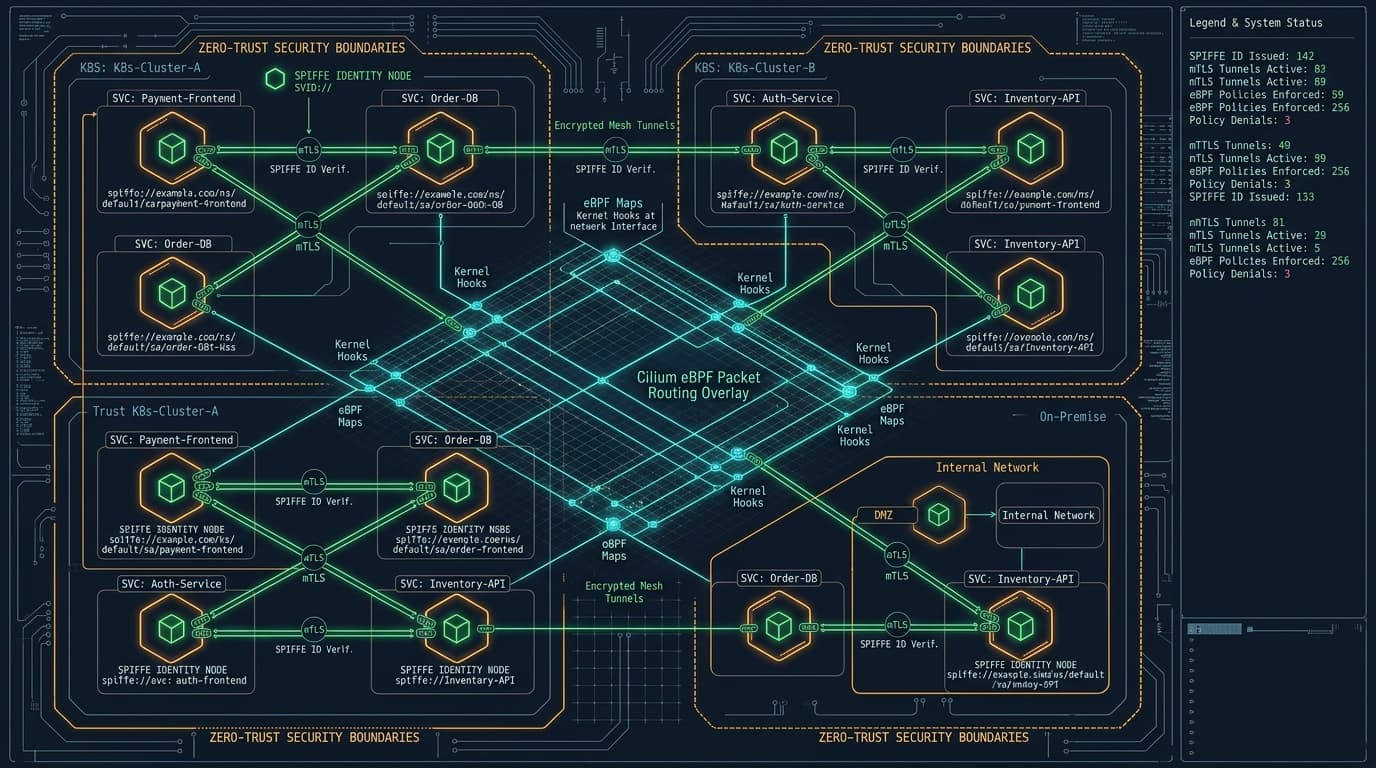
Zero-Trust hardware enclave architecture utilizing AMD SEV-SNP and Intel TDX, encrypting virtual machine memory in-use to protect cryptographic keys and proprietary models from hypervisor and cloud provider access.
Adversary Threat Model
Rogue cloud provider administrator or compromised hypervisor process inspects RAM memory to extract TLS private keys or proprietary LLM weights.
Architecture Specs
NIST SP 800-207 Tenets Enforced
- ✓All data sources and computing services are considered resources.
- ✓No asset is inherently trusted.
MITRE ATT&CK Techniques Blocked
3 Maturity Tier Configurations
Evolutionary engineering configurations from baseline Initial up to CISA Optimal zero-compromise fortress.
Memory encryption enabled at hypervisor level without cryptographic attestation.
Standard cloud instance IAM credentials.
Encrypted VPC subnet.
Cloud provider instance launch state logs.
Confidential VMs (GCP Confidential VM / AWS C6a) with remote hardware attestation.
Key release policy requiring valid AMD SEV-SNP hardware attestation report before decryption.
Isolated enclave network with zero direct internet access.
Cryptographic attestation verification logs stored in tamper-proof bucket.
Entire AI training and financial ledger processing running in confidential container enclaves.
Zero-knowledge hardware attestation with multi-party verifiable computation.
Private memory encryption keys regenerated per container lifecycle.
Continuous cryptographic measurement matching public reproducible build hash.
Infrastructure as Code: Terraform & Kubernetes
Production-ready declarative manifests for immediate automated deployment.
resource "google_compute_instance" "confidential_vm" {
  name         = "tinycto-secure-ledger"
  machine_type = "n2d-standard-8"
  zone         = "us-central1-a"

  confidential_instance_config {
    enable_confidential_compute = true
  }

  boot_disk {
    initialize_params {
      image = "ubuntu-os-cloud/ubuntu-2204-lts"
    }
    kms_key_self_link = var.kms_key_link
  }
}apiVersion: v1
kind: Pod
metadata:
name: confidential-worker
spec:
nodeSelector:
cloud.google.com/confidential-compute: "true"
containers:
- name: secure-processor
image: ghcr.io/tiny-cto/ledger:latest
resources:
limits:
memory: "16Gi"
cpu: "4"Zero-Trust hardware enclave architecture utilizing AMD SEV-SNP and Intel TDX, encrypting virtual machine memory in-use to protect cryptographic keys and proprietary models from hypervisor and cloud provider access.
Architecture Blueprint FAQs
How does the Confidential Computing with AMD SEV-SNP Memory Encryption blueprint mitigate adversary threats and MITRE ATT&CK techniques?
Confidential Computing with AMD SEV-SNP Memory Encryption addresses the following adversary profile: Rogue cloud provider administrator or compromised hypervisor process inspects RAM memory to extract TLS private keys or proprietary LLM weights. It actively eliminates lateral movement and privilege escalation by mitigating: T1005, T1055, T1530, T1003 via hardware-rooted identity, kernel-level enforcement, or continuous attestation.
Which NIST SP 800-207 Zero-Trust tenets does this architecture enforce?
This blueprint strictly operationalizes the following NIST SP 800-207 tenets: All data sources and computing services are considered resources.; No asset is inherently trusted.. Implicit trust based on network location is replaced with per-session dynamic cryptographic verification.
What are the technical differences between the Initial and Optimal maturity tiers?
The Initial tier focuses on baseline policy and identity enforcement (Memory encryption enabled at hypervisor level without cryptographic attestation.), while the Optimal tier delivers CISA ZTMM 2.0 zero-compromise fortress defense (Entire AI training and financial ledger processing running in confidential container enclaves.) using: constellation-k8s, amd-sev-snp, marblerun, gramine.
What is the primary failure mode risk and how is high availability guaranteed?
The primary failure risk is identified as: Performance penalty (~3-7% CPU overhead) on memory-bandwidth intensive workloads.. Resilience is maintained through active-active control planes, local cached attestations, and graceful degradation playbooks.
How can engineering teams automate this architecture using Terraform and Kubernetes?
The provided declarative Terraform HCL (main.tf) and Kubernetes policy manifests (policy.yaml) can be immediately integrated into automated GitOps CI/CD pipelines (e.g., ArgoCD, Flux) for reproducible, drift-detected infrastructure provisioning.