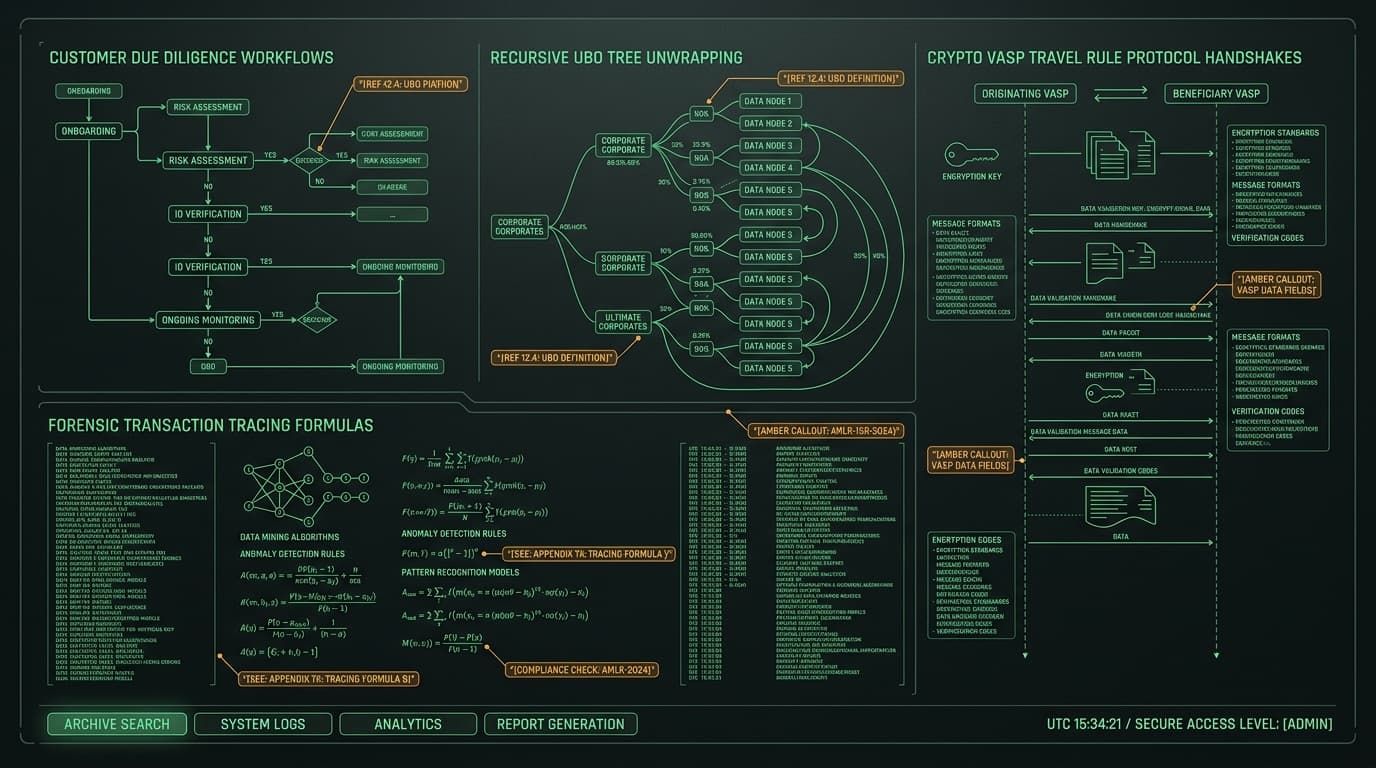
Virtual Assets, On-Chain Forensics & Travel Rule Implementation
On-chain cluster heuristics, peeling chain detection, and inter-VASP Travel Rule federation protocols using IVMS 101 schemas.
#6.1 The Virtual Asset Compliance Paradigm
Virtual assets introduce unique compliance challenges: pseudonymous blockchain addresses, decentralized cross-border execution, and cryptographic mixing protocols. Under FATF Recommendation 15, Virtual Asset Service Providers (VASPs) are subject to the full suite of AML/CFT requirements applicable to traditional financial institutions.
#6.2 On-Chain Cluster Forensics & Peeling Chains
Unlike fiat wires which rely on bank routing identifiers, crypto transactions leave permanent immutable ledgers. Specialized forensic indexing engines analyze blockchain graphs using clustering heuristics:
- Co-Spend Heuristic: Addresses used as inputs in a multi-input transaction are presumed to belong to the same wallet entity.
- Change Address Detection: Algorithmic identification of return addresses based on script type, unrounded amounts, and network fee patterns.
- Peeling Chain Tracking: Identifying money laundering sequences where a large initial illicit deposit is systematically peeled into hundreds of smaller transactions while small change balances continue through transit wallets.
- Taint Exposure Scoring: Measuring direct (hop 1) and indirect (hops 2-5) financial exposure to darknet markets, sanctioned wallets, ransomware exploits, and mixing smart contracts.
#6.3 The Travel Rule (FATF Rec 16 & EU TFR)
The Travel Rule requires VASPs to obtain and securely transmit verified originator and beneficiary identity information alongside crypto asset transfers exceeding statutory thresholds (e.g. $1,000 / €1,000).
Inter-VASP Federation Protocols
VASPs utilize cryptographic messaging networks such as TRISA (Travel Rule Information Sharing Architecture), OpenVASP, or Notabene:
- Originating VASP queries counterparty directory to verify that the destination address belongs to an accredited, regulated VASP.
- An encrypted payload conforming to the IVMS 101 data standard (InterVASP Messaging Standard) is transmitted via mutual-TLS.
- The destination VASP validates the beneficiary identity against its internal customer database.
- Only upon successful cryptographic handshake is the on-chain transfer authorized and released.