> 12_ARCHITECTURES_v1.0
Canonical Financial Compliance Architectures
12 reference architectures across streaming monitoring, UBO graph unwrapping, and sanctions screening, sized across 36 maturity targets.
Real-Time Streaming Transaction Monitoring Architecture
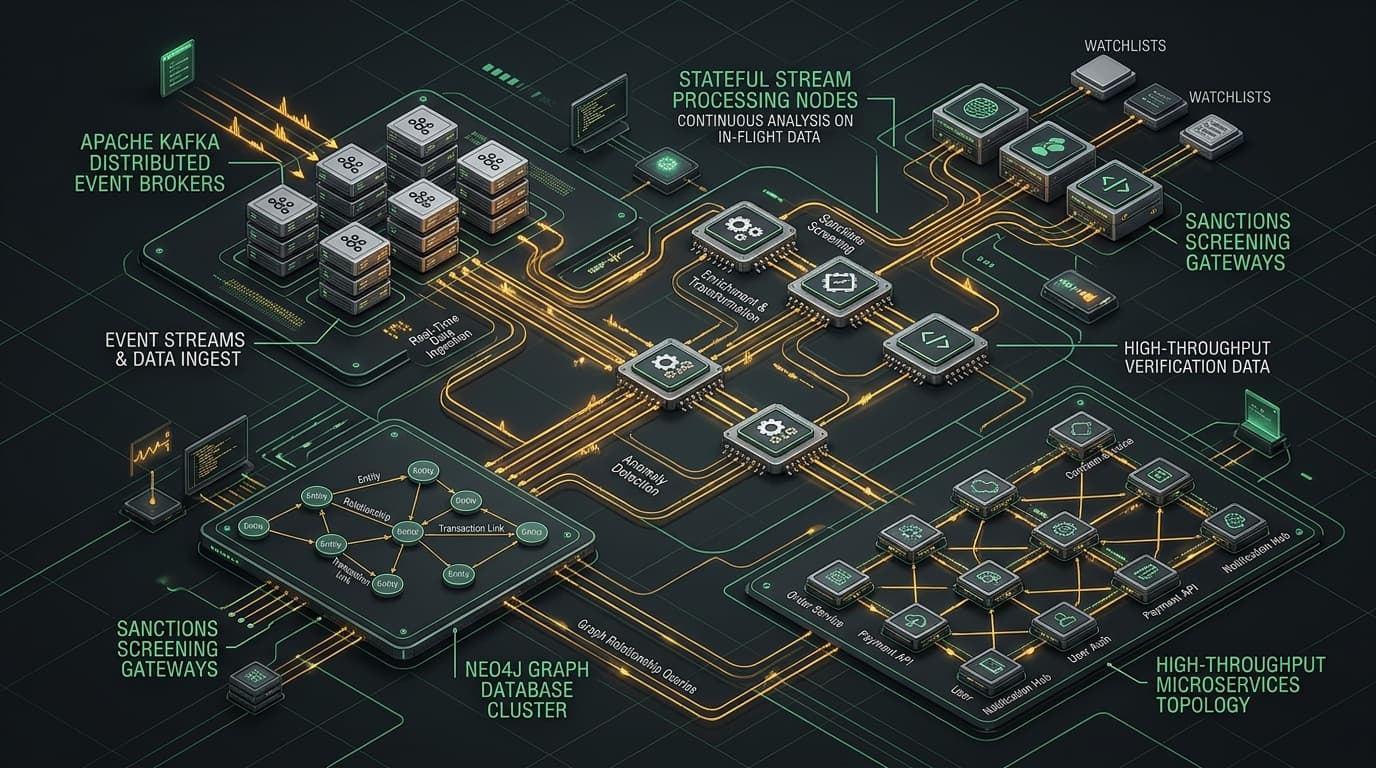
Sub-second event-driven stream processing architecture combining Apache Kafka and Apache Flink for real-time velocity calculations, structuring detection, and immediate payment intervention.
Low-Latency Multilingual Sanctions & PEP Screening Pipeline
Deterministic and phonetic transliteration screening pipeline capable of cross-referencing SWIFT/ISO 20022 messages against UN, OFAC, and EU sanctions lists within 30 milliseconds.
Graph Network UBO & Counterparty Clustering Architecture
Graph-native knowledge base engineered to unwrap complex multi-jurisdictional holding structures, identify true beneficial owners, and detect circular money laundering rings.
Explainable AI (XAI) Alert Triage & Hibernation Pipeline
Secondary ML ranking architecture that triages incoming alerts, suppressing low-risk recurring false positives while generating local SHAP feature attributions for human investigators.
Virtual Asset On-Chain Forensics & Travel Rule Gateway
Comprehensive crypto compliance architecture uniting real-time wallet deposit taint scoring, mixer interaction detection, and automated counterparty VASP identity exchange via Travel Rule protocols.
Trade-Based Money Laundering (TBML) & Dual-Use Inspection System
Multi-modal trade surveillance architecture cross-referencing OCR-parsed shipping invoices with global commodity market price indices, HS dual-use tariff databases, and satellite AIS vessel tracking.
Air-Gapped Anti-Tipping-Off Case & SAR Filing Architecture
Zero-knowledge cryptographic investigation vault strictly isolated from operational front-office banking systems, governing MLRO review, evidence redaction, and electronic filing to national FIUs.
Continuous Adverse Media & Public Registry NLP Surveillance
Continuous entity intelligence pipeline that ingests global multilingual news feeds, judicial dockets, and official gazettes to update customer risk scores based on newly published financial crime allegations.
Unified FRAML (Fraud + AML) Cross-Channel Defense Architecture
Integrated architecture breaking the operational silos between real-time payment fraud prevention and statutory anti-money laundering monitoring, recognizing that fraud losses directly constitute AML predicate offenses.
Privacy-Preserving Interbank Consortium & Zero-Knowledge Intelligence
Collaborative interbank intelligence architecture utilizing secure multi-party computation (SMPC) and zero-knowledge proofs to identify money mule rings and duplicate factoring fraud across institutions without sharing raw customer PII.
Fair, Non-Discriminatory & Contestable De-Risking Governance Architecture
Compliance governance architecture designed to prevent discriminatory de-banking, enforcing statistical demographic parity tests on ML models, mandatory human oversight for account terminations, and an accessible customer appeal portal.
Continuous Model Risk Management (MRM) & Emergency Drift Remediation
Enterprise model validation infrastructure adhering to Federal Reserve SR 11-7 and EU AI Act mandates, continuously monitoring feature drift, tracking concept decay, and triggering automated rollback to conservative rule-based baselines.
Catalogue of 12 canonical financial integrity reference architectures spanning 36 maturity targets (PROTOTYPE, PRODUCTION_CANDIDATE, REGULATED_PRODUCTION). Each architecture provides sub-second p95 latency bounds, Kafka/Flink streaming pipelines, phonetic non-Latin transliteration engines, and strict HSM-backed audit trails.
Architectures FAQ
How do the 12 reference architectures scale across maturity configurations?
Each architecture defines three deterministic tiers: Prototype (low-cost evaluation using Docker and embedded engines), Production Candidate (fault-tolerant clustered deployment with sub-100ms latency), and Regulated Production (air-gapped HSM encryption, multi-region replication, and statutory SR 11-7 model governance).
What latency SLA guarantees are provided by FI-ARCH-01 Streaming Transaction Monitoring?
FI-ARCH-01 achieves a sub-second p95 latency under 100 milliseconds for live event evaluation, processing up to 25,000 transactions per second (TPS) on clustered Apache Kafka and Apache Flink CEP engines.
How does FI-ARCH-03 UBO Graph Unwrapping prevent cycle-induced stack overflows?
The recursive unwrapping engine maintains an in-memory visited node ledger with cycle detection. If a circular ownership loop is encountered, recursion terminates for that path and flags a deliberate obfuscation topology for forensic investigator review.
What cryptographic separation enforces the air-gapped vault in FI-ARCH-08?
FI-ARCH-08 isolates STR/SAR records into a separate VPC with zero ingress from the corporate CRM. All payloads are encrypted using envelope encryption with FIPS 140-3 Level 3 HSM keys, preventing administrative elevation or accidental tipping-off.
How does FI-ARCH-04 Sanctions Screening handle non-Latin script aliases?
It integrates a multi-lingual transliteration layer that converts Cyrillic, Arabic, and Farsi into phonetic canonical representations before executing combined vector similarity and Double Metaphone matching within a strict 30ms SLA.
Can these reference architectures be deployed on hybrid cloud or on-premises infrastructure?
Yes. All 12 reference architectures are built on containerized cloud-native standards (Kubernetes, Apache Kafka, Apache Flink, PostgreSQL, Neo4j) with zero proprietary lock-in, enabling deployment across AWS, Azure, GCP, or sovereign private datacenters.