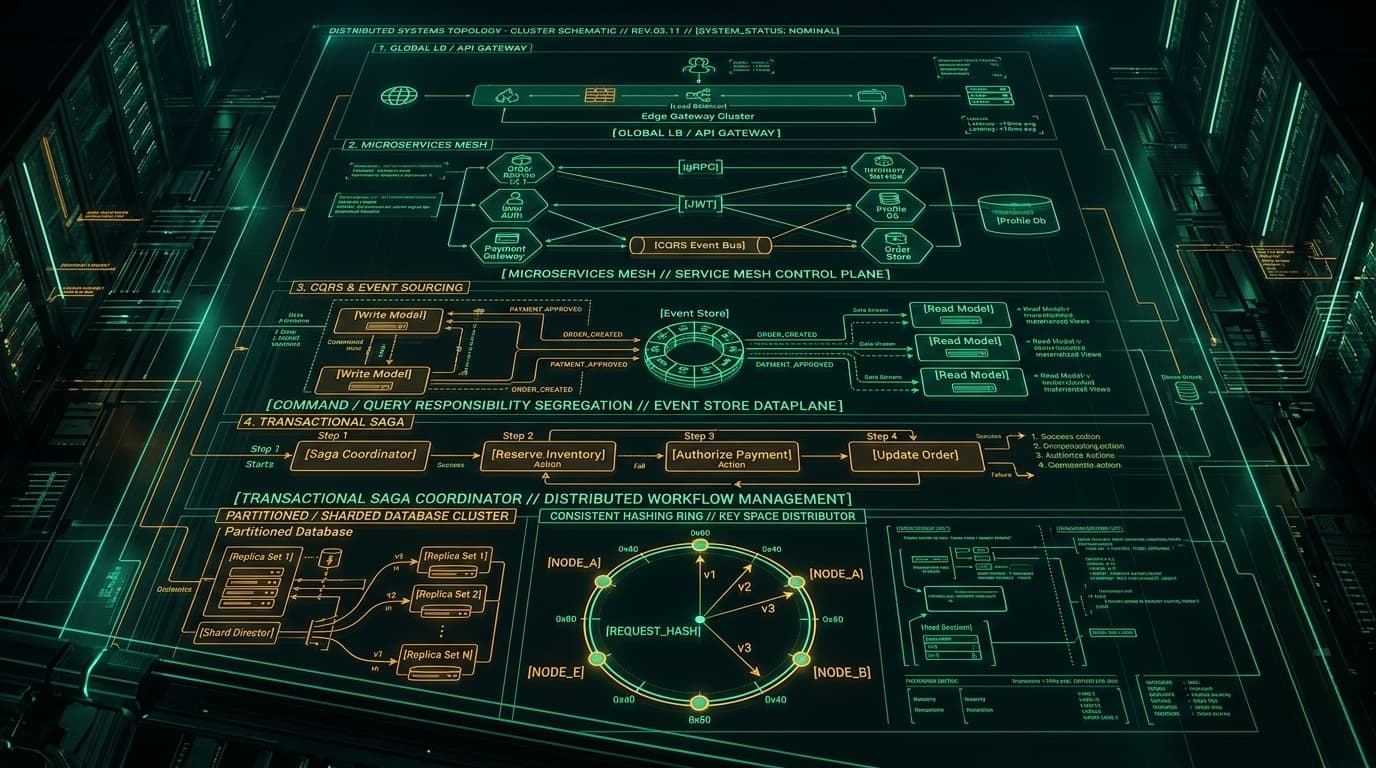
> EVENT_SOURCING_CQRS // None // AP
Production Append-Only Event Store with Real-Time CQRS Projections
Immutable event store recording domain facts as append-only streams, asynchronously projecting real-time materialized read models into optimized query datastores.
Problem Statement & Architectural Hypothesis
CRUD architectures overwrite state in place, destroying historical audit trails and creating massive lock contention between write mutations and complex analytics queries.
Formal Distributed Guarantees
- ⚡Immutable 100% forensic audit trail
- ⚡Deterministic historical state rehydration to any point in time ($t$)
- ⚡Sub-millisecond query read latency via specialized denormalized projections
Handled Failure Modes
3 Maturity & Scale Configurations
Step-by-step production configurations from single-cluster baseline up to multi-datacenter ultra-scale.
3,000 events/sec
< 45ms
Eventual Consistency (Projection Lag < 500ms)
Single PostgreSQL instance with an append-only `events` table and an optimistic concurrency version column.
45,000 events/sec
< 10ms
Strict Optimistic Concurrency + Real-time Streaming Projections
3-node EventStoreDB cluster paired with Kafka connect projections feeding Elasticsearch read models.
400,000 events/sec
< 2.5ms
Sub-10ms Global Read Projections with CQRS Snapshot Compaction
Apache Flink streaming cluster aggregating millions of raw events per second into in-memory read models.
Infrastructure as Code: Terraform, Kubernetes & Engine Configs
Production-ready automation manifests ready for deployment on Kubernetes and cloud providers.
resource "aws_opensearch_domain" "read_projections" {
  domain_name    = "tinycto-read-projections"
  engine_version = "OpenSearch_2.11"

  cluster_config {
    instance_type  = "r6g.xlarge.search"
    instance_count = 3
  }
}apiVersion: apps/v1
kind: Deployment
metadata:
name: order-projection-engine
spec:
replicas: 4
template:
spec:
containers:
- name: projector
image: tinycto/order-projector:v2.1
env:
- name: KAFKA_BOOTSTRAP_SERVERS
value: "kafka:9092"
- name: TARGET_ELASTICSEARCH_URL
value: "http://opensearch:9200"CREATE TABLE domain_events ( aggregate_id UUID NOT NULL, version BIGINT NOT NULL, event_type VARCHAR(128) NOT NULL, payload JSONB NOT NULL, occurred_at TIMESTAMPTZ NOT NULL DEFAULT NOW(), PRIMARY KEY (aggregate_id, version) );
Immutable event store recording domain facts as append-only streams, asynchronously projecting real-time materialized read models into optimized query datastores.
Architecture Blueprint FAQs
What is the mathematical CAP and PACELC classification of Production Append-Only Event Store with Real-Time CQRS Projections?
Production Append-Only Event Store with Real-Time CQRS Projections is classified under CAP as AP and under PACELC as PA/EL. During network partitions, it prioritizes availability, maintaining strict state guarantees.
How does the None consensus protocol operate in this architecture?
This blueprint relies on None for quorum-based state machine replication. Leader election, log compaction, and split-brain prevention are enforced through monotonic terms and fencing tokens.
Which distributed failure modes does this architecture handle?
The architecture explicitly handles the following failure modes: DS-FAIL-02: Dual-Write Mutation Drift, DS-FAIL-10: Out-of-Order CDC Ingestion, DS-FAIL-18: Event Sourcing Upcaster Failure, ensuring no silent divergence or message loss.
What are the throughput and latency differentials between Initial and Ultra-Scale tiers?
The Initial tier targets 3,000 events/sec with < 45ms p99 latency (Single PostgreSQL instance with an append-only `events` table and an optimistic concurrency version column.), whereas Ultra-Scale scales to 400,000 events/sec with < 2.5ms (Apache Flink streaming cluster aggregating millions of raw events per second into in-memory read models.) using: Apache Flink Stateful Stream Processor, Apache Cassandra Event Store, Aerospike Read Cache.
How is this architecture provisioned via declarative Infrastructure as Code?
The provided Terraform HCL, Kubernetes manifest, and engine configuration properties furnish immediate production templates for Kubernetes clusters and event broker topologies.