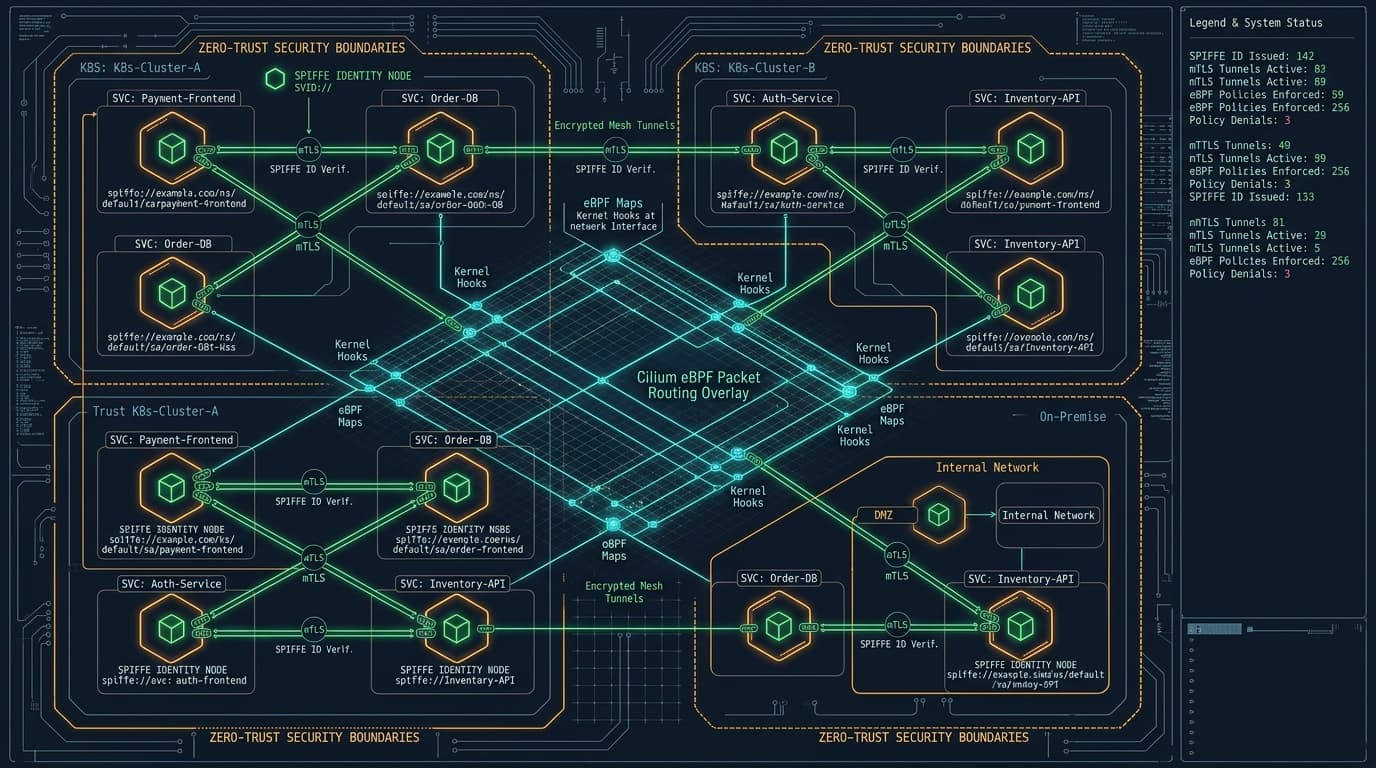
> ZERO-TRUST // zt-arch-01
SPIFFE/SPIRE Cryptographic Workload Attestation
Hardware and kernel-verified workload identity issuance using SPIFFE IDs and short-lived X.509 SVIDs, establishing mutual TLS between microservices with zero static credentials.
Adversary Threat Model
Adversary compromises host network or local container namespace, attempting to forge service identity or sniff inter-service RPC payloads.
Architecture Specs
NIST SP 800-207 Tenets Enforced
- ✓All data sources and computing services are considered resources.
- ✓All communication is secured regardless of network location.
- ✓Access to individual enterprise resources is granted on a per-session basis.
MITRE ATT&CK Techniques Blocked
3 Maturity Tier Configurations
Evolutionary engineering configurations from baseline Initial up to CISA Optimal zero-compromise fortress.
Namespace-local SPIRE server with static node selectors.
mTLS enforced on edge ingress; internal RPC optional.
Default cluster overlay without kernel attestation.
Basic SPIRE audit logs to standard output.
Multi-cluster federated SPIRE deployment with Kubernetes Workload Registrar.
Strict mTLS enforced across 100% of inter-service gRPC/HTTP calls.
Integration with Cilium eBPF identity-aware network policies.
Structured JSON audit stream to OpenTelemetry collector with trace correlation.
Hardware TPM 2.0 attested SPIRE agents with multi-cloud OIDC federation.
Sub-hour ephemeral SVIDs with hardware-rooted platform attestation.
Kernel-enforced transparent proxying with post-quantum hybrid ciphers.
Continuous behavioral anomaly scoring on SVID issuance rate anomalies.
Infrastructure as Code: Terraform & Kubernetes
Production-ready declarative manifests for immediate automated deployment.
resource "helm_release" "spire" {
  name       = "spire"
  repository = "https://spiffe.github.io/helm-charts"
  chart      = "spire"
  namespace  = "spire"

  set {
    name  = "server.caTTL"
    value = "168h"
  }
  set {
    name  = "server.defaultSVIDTTL"
    value = "1h"
  }
}apiVersion: spire.spiffe.io/v1alpha1
kind: ClusterSPIFFEID
metadata:
name: billing-workload
spec:
spiffeIDTemplate: "spiffe://tinycto.tv/ns/{{ .PodMeta.Namespace }}/sa/{{ .PodSpec.ServiceAccountName }}"
podSelector:
matchLabels:
app.kubernetes.io/part-of: billing-systemHardware and kernel-verified workload identity issuance using SPIFFE IDs and short-lived X.509 SVIDs, establishing mutual TLS between microservices with zero static credentials.
Architecture Blueprint FAQs
How does the SPIFFE/SPIRE Cryptographic Workload Attestation blueprint mitigate adversary threats and MITRE ATT&CK techniques?
SPIFFE/SPIRE Cryptographic Workload Attestation addresses the following adversary profile: Adversary compromises host network or local container namespace, attempting to forge service identity or sniff inter-service RPC payloads. It actively eliminates lateral movement and privilege escalation by mitigating: T1078.004, T1552.004, T1021.002, T1040 via hardware-rooted identity, kernel-level enforcement, or continuous attestation.
Which NIST SP 800-207 Zero-Trust tenets does this architecture enforce?
This blueprint strictly operationalizes the following NIST SP 800-207 tenets: All data sources and computing services are considered resources.; All communication is secured regardless of network location.; Access to individual enterprise resources is granted on a per-session basis.. Implicit trust based on network location is replaced with per-session dynamic cryptographic verification.
What are the technical differences between the Initial and Optimal maturity tiers?
The Initial tier focuses on baseline policy and identity enforcement (Namespace-local SPIRE server with static node selectors.), while the Optimal tier delivers CISA ZTMM 2.0 zero-compromise fortress defense (Hardware TPM 2.0 attested SPIRE agents with multi-cloud OIDC federation.) using: spire-tpm-plugin, spire-federation, cilium-ebpf, cosign, tetragon.
What is the primary failure mode risk and how is high availability guaranteed?
The primary failure risk is identified as: TPM quota exhaustion during massive simultaneous node reboot.. Resilience is maintained through active-active control planes, local cached attestations, and graceful degradation playbooks.
How can engineering teams automate this architecture using Terraform and Kubernetes?
The provided declarative Terraform HCL (main.tf) and Kubernetes policy manifests (policy.yaml) can be immediately integrated into automated GitOps CI/CD pipelines (e.g., ArgoCD, Flux) for reproducible, drift-detected infrastructure provisioning.