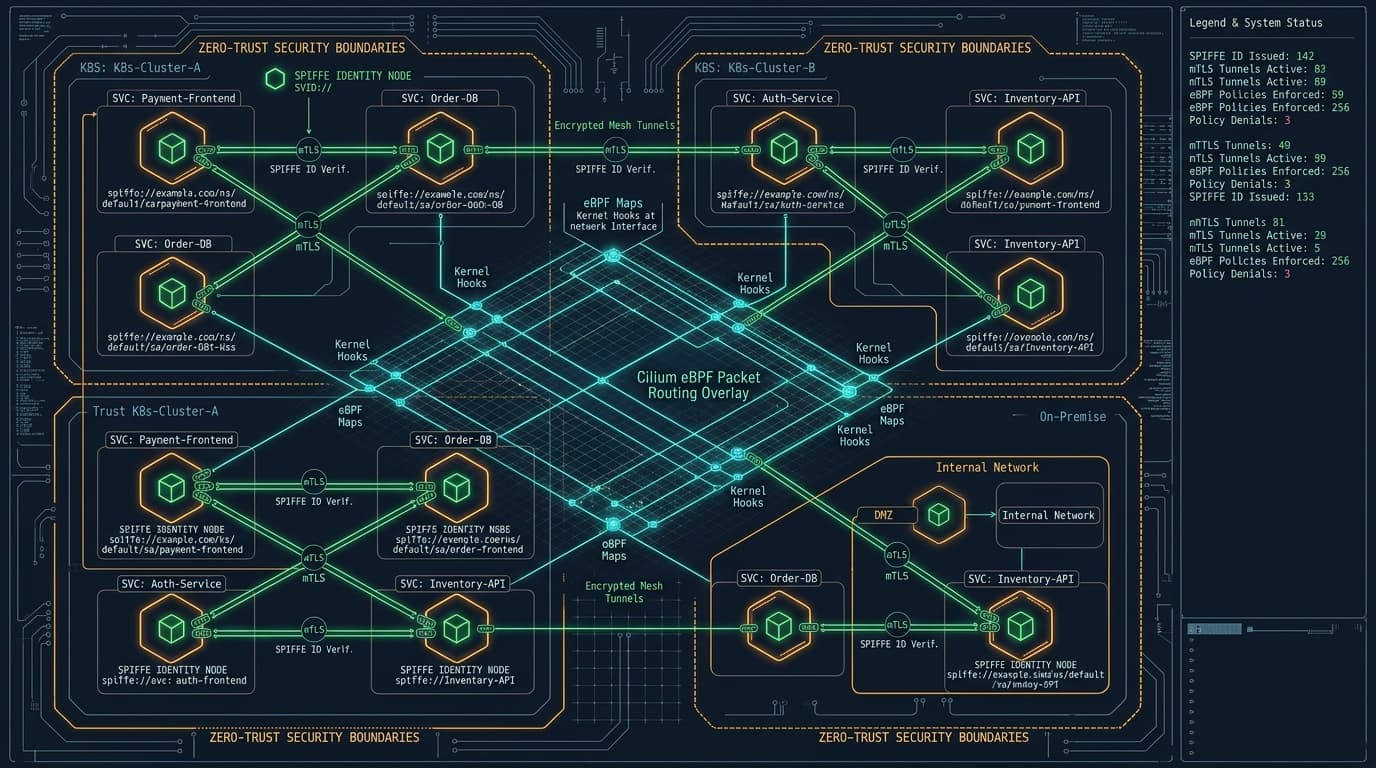
> ZERO-TRUST // zt-arch-11
Peer-to-Peer Zero-Trust Mesh with Ephemeral WireGuard
Lightweight, self-hosted, peer-to-peer overlay network powered by WireGuard and Headscale, establishing point-to-point encrypted tunnels with short-lived key pairs and identity-based access control.
Adversary Threat Model
Adversary taps public cloud WAN or cloud interconnect lines, attempting unauthenticated packet injection into private cluster nodes.
Architecture Specs
NIST SP 800-207 Tenets Enforced
- ✓All communication is secured regardless of network location.
- ✓Access to resources is determined by dynamic policy.
MITRE ATT&CK Techniques Blocked
3 Maturity Tier Configurations
Evolutionary engineering configurations from baseline Initial up to CISA Optimal zero-compromise fortress.
Static WireGuard tunnels connecting production nodes to central bastion.
Long-lived public/private key pairs exchanged manually.
Point-to-point tunnel encryption.
Kernel WireGuard transfer byte counters.
Self-hosted Headscale control plane managing peer routing across multiple cloud providers.
OIDC integration for node pre-authentication and automated key rotation every 24h.
ACL-based microsegmentation restricting inter-node traffic per tag.
Headscale API audit logs streamed to central syslog.
Mesh topology with sub-hour ephemeral key regeneration and hardware-rooted attestation.
Continuous posture assessment verifying host integrity before routing updates.
Default-deny mesh; nodes cannot discover each other without cryptographic authorization.
Kernel-level connection telemetry with automated anomaly quarantine.
Infrastructure as Code: Terraform & Kubernetes
Production-ready declarative manifests for immediate automated deployment.
resource "helm_release" "headscale" {
  name       = "headscale"
  repository = "https://headscale.net/helm"
  chart      = "headscale"
  namespace  = "vpn"

  set {
    name  = "config.server_url"
    value = "https://headscale.internal.tinycto.tv"
  }
  set {
    name  = "config.oidc.issuer"
    value = "https://auth.tinycto.tv/realms/tinycto"
  }
}apiVersion: v1
kind: ConfigMap
metadata:
name: headscale-acls
namespace: vpn
data:
acls.hujson: |
{
"acls": [
{"action": "accept", "src": ["tag:prod-api"], "dst": ["tag:prod-db:5432"]},
{"action": "accept", "src": ["tag:ops"], "dst": ["*:22"]}
]
}Lightweight, self-hosted, peer-to-peer overlay network powered by WireGuard and Headscale, establishing point-to-point encrypted tunnels with short-lived key pairs and identity-based access control.
Architecture Blueprint FAQs
How does the Peer-to-Peer Zero-Trust Mesh with Ephemeral WireGuard blueprint mitigate adversary threats and MITRE ATT&CK techniques?
Peer-to-Peer Zero-Trust Mesh with Ephemeral WireGuard addresses the following adversary profile: Adversary taps public cloud WAN or cloud interconnect lines, attempting unauthenticated packet injection into private cluster nodes. It actively eliminates lateral movement and privilege escalation by mitigating: T1040, T1557, T1021 via hardware-rooted identity, kernel-level enforcement, or continuous attestation.
Which NIST SP 800-207 Zero-Trust tenets does this architecture enforce?
This blueprint strictly operationalizes the following NIST SP 800-207 tenets: All communication is secured regardless of network location.; Access to resources is determined by dynamic policy.. Implicit trust based on network location is replaced with per-session dynamic cryptographic verification.
What are the technical differences between the Initial and Optimal maturity tiers?
The Initial tier focuses on baseline policy and identity enforcement (Static WireGuard tunnels connecting production nodes to central bastion.), while the Optimal tier delivers CISA ZTMM 2.0 zero-compromise fortress defense (Mesh topology with sub-hour ephemeral key regeneration and hardware-rooted attestation.) using: headscale-ha, wireguard-kernel, tpm2-tools, tetragon.
What is the primary failure mode risk and how is high availability guaranteed?
The primary failure risk is identified as: Mesh routing table flapping during rapid autoscaling events.. Resilience is maintained through active-active control planes, local cached attestations, and graceful degradation playbooks.
How can engineering teams automate this architecture using Terraform and Kubernetes?
The provided declarative Terraform HCL (main.tf) and Kubernetes policy manifests (policy.yaml) can be immediately integrated into automated GitOps CI/CD pipelines (e.g., ArgoCD, Flux) for reproducible, drift-detected infrastructure provisioning.