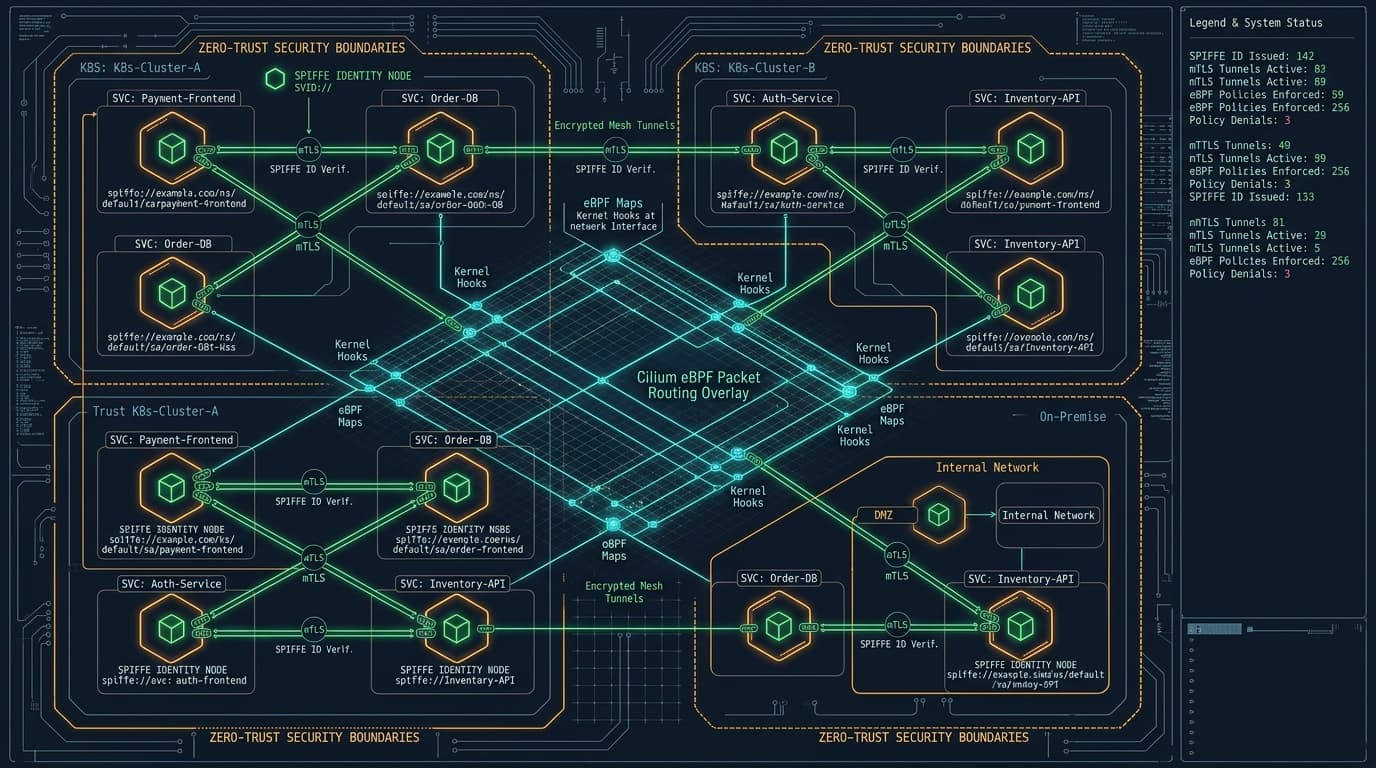
> ZERO-TRUST // zt-arch-05
Kernel-Level eBPF L3-L7 Kubernetes Microsegmentation
High-performance in-kernel network microsegmentation using Cilium eBPF, replacing slow iptables with cryptographic identity-aware L3/L4/L7 packet filtering and transparent WireGuard encryption.
Adversary Threat Model
Compromised web container initiates port scanning and attempts lateral HTTP/database exploitation across cluster namespaces.
Architecture Specs
NIST SP 800-207 Tenets Enforced
- ✓All communication is secured regardless of network location.
- ✓Access to resources is determined by dynamic policy including client identity and application characteristics.
MITRE ATT&CK Techniques Blocked
3 Maturity Tier Configurations
Evolutionary engineering configurations from baseline Initial up to CISA Optimal zero-compromise fortress.
Cilium installed in kube-proxy replacement mode across single cluster.
L3/L4 NetworkPolicies blocking cross-namespace traffic by default.
Pod-to-pod network separation without in-transit encryption.
Hubble CLI monitoring active network flows.
Multi-cluster Cilium ClusterMesh with transparent node-to-node WireGuard encryption.
L7 HTTP/gRPC method and path authorization enforced via eBPF.
DNS-aware egress policies restricting pods to explicit external FQDNs.
Hubble UI and Prometheus flow metrics exported to enterprise Grafana dashboard.
Zero-trust runtime fabric with eBPF-enforced SPIFFE identity validation and BGP peering.
Cryptographic mutual authentication per packet with automated revocation.
Complete isolation of control plane, tenant workloads, and GPU compute fabrics.
Kernel-level real-time flow tracing integrated with automated SIEM threat blocking.
Infrastructure as Code: Terraform & Kubernetes
Production-ready declarative manifests for immediate automated deployment.
resource "helm_release" "cilium" {
  name       = "cilium"
  repository = "https://helm.cilium.io/"
  chart      = "cilium"
  namespace  = "kube-system"

  set {
    name  = "kubeProxyReplacement"
    value = "true"
  }
  set {
    name  = "encryption.enabled"
    value = "true"
  }
  set {
    name  = "encryption.type"
    value = "wireguard"
  }
}apiVersion: "cilium.io/v2"
kind: CiliumNetworkPolicy
metadata:
name: "secure-payment-gateway"
namespace: "production"
spec:
endpointSelector:
matchLabels:
app: payment-api
ingress:
- fromEndpoints:
- matchLabels:
app: checkout-frontend
toPorts:
- ports:
- port: "8443"
protocol: TCP
rules:
http:
- method: "POST"
path: "/v1/charges"
egress:
- toFQDNs:
- matchName: "api.stripe.com"
toPorts:
- ports:
- port: "443"
protocol: TCPHigh-performance in-kernel network microsegmentation using Cilium eBPF, replacing slow iptables with cryptographic identity-aware L3/L4/L7 packet filtering and transparent WireGuard encryption.
Architecture Blueprint FAQs
How does the Kernel-Level eBPF L3-L7 Kubernetes Microsegmentation blueprint mitigate adversary threats and MITRE ATT&CK techniques?
Kernel-Level eBPF L3-L7 Kubernetes Microsegmentation addresses the following adversary profile: Compromised web container initiates port scanning and attempts lateral HTTP/database exploitation across cluster namespaces. It actively eliminates lateral movement and privilege escalation by mitigating: T1046, T1021, T1090, T1567 via hardware-rooted identity, kernel-level enforcement, or continuous attestation.
Which NIST SP 800-207 Zero-Trust tenets does this architecture enforce?
This blueprint strictly operationalizes the following NIST SP 800-207 tenets: All communication is secured regardless of network location.; Access to resources is determined by dynamic policy including client identity and application characteristics.. Implicit trust based on network location is replaced with per-session dynamic cryptographic verification.
What are the technical differences between the Initial and Optimal maturity tiers?
The Initial tier focuses on baseline policy and identity enforcement (Cilium installed in kube-proxy replacement mode across single cluster.), while the Optimal tier delivers CISA ZTMM 2.0 zero-compromise fortress defense (Zero-trust runtime fabric with eBPF-enforced SPIFFE identity validation and BGP peering.) using: cilium-enterprise, tetragon, spire, hubble-timescape.
What is the primary failure mode risk and how is high availability guaranteed?
The primary failure risk is identified as: Kernel version incompatibility requiring phased node OS rollouts.. Resilience is maintained through active-active control planes, local cached attestations, and graceful degradation playbooks.
How can engineering teams automate this architecture using Terraform and Kubernetes?
The provided declarative Terraform HCL (main.tf) and Kubernetes policy manifests (policy.yaml) can be immediately integrated into automated GitOps CI/CD pipelines (e.g., ArgoCD, Flux) for reproducible, drift-detected infrastructure provisioning.