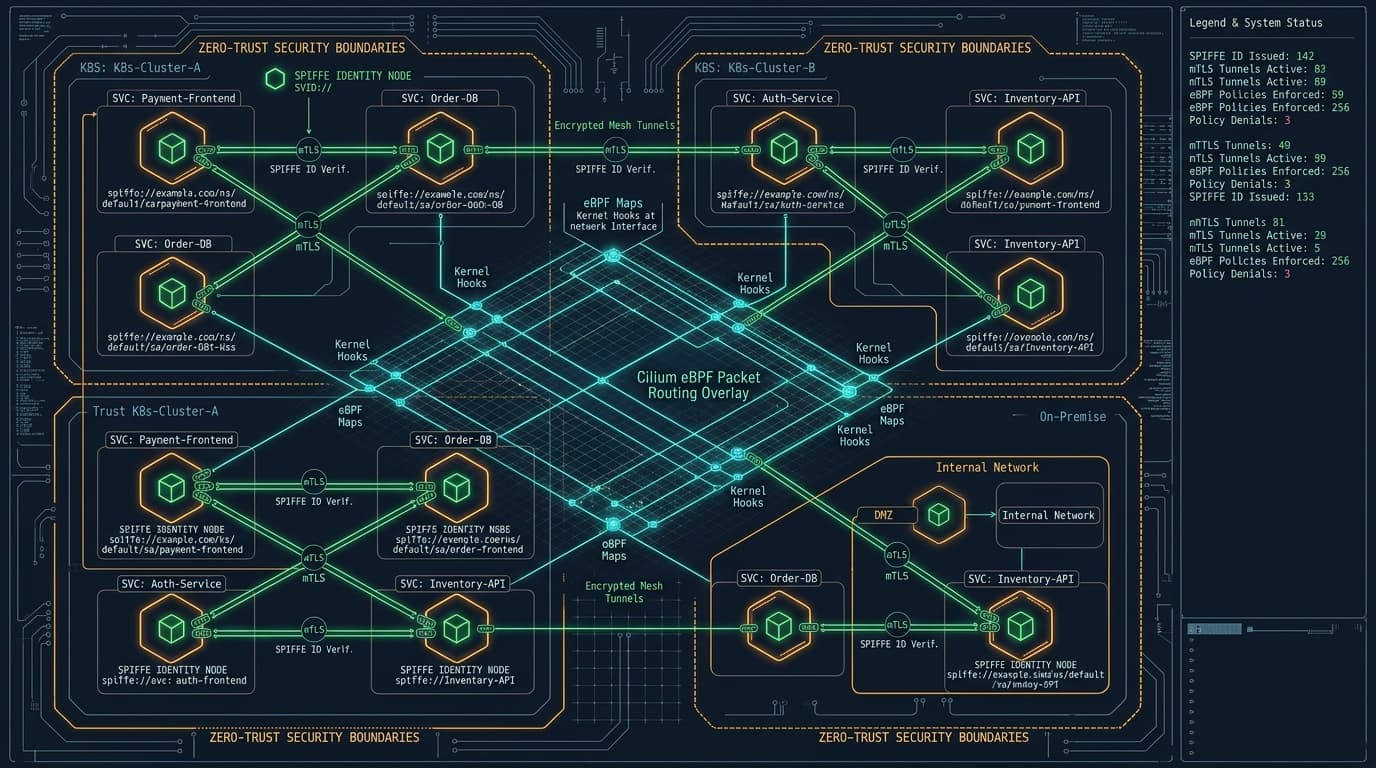
> ZERO-TRUST // zt-arch-16
Continuous Breach & Attack Simulation (BAS)
Continuous adversarial resilience validation framework executing automated chaos security experiments and MITRE ATT&CK techniques in production to mathematically prove Zero-Trust policy efficacy.
Adversary Threat Model
Silent policy misconfiguration or firewall bypass remains undetected until exploited by real-world adversary during incident.
Architecture Specs
NIST SP 800-207 Tenets Enforced
- ✓The enterprise monitors and measures the integrity and security posture of all owned and associated assets.
- ✓No asset is inherently trusted.
MITRE ATT&CK Techniques Blocked
3 Maturity Tier Configurations
Evolutionary engineering configurations from baseline Initial up to CISA Optimal zero-compromise fortress.
Annual third-party penetration testing and quarterly vulnerability scans.
Manual evaluation of findings.
Standard staging environment testing.
PDF summary report shared with engineering management.
Automated weekly Breach & Attack Simulation (BAS) validating network policy enforcement and EDR alerts.
Simulated credential theft and lateral movement attempts executed programmatically.
Canary namespaces with real production security policy enforcement.
Detection coverage score tracked continuously in engineering KPI dashboards.
Continuous autonomous adversary emulation integrated into CI/CD deployment gates.
Deployments blocked automatically if security control fails simulated attack validation.
Live production chaos security injection with automated blast radius constraints.
Real-time mean time to detect (MTTD) and mean time to respond (MTTR) calculation.
Infrastructure as Code: Terraform & Kubernetes
Production-ready declarative manifests for immediate automated deployment.
resource "aws_cloudwatch_event_rule" "weekly_security_chaos" {
  name                = "weekly-security-chaos-simulation"
  schedule_expression = "cron(0 2 ? * TUE *)"
}apiVersion: batch/v1
kind: CronJob
metadata:
name: stratus-red-team-runner
namespace: security-audit
spec:
schedule: "0 3 * * *"
jobTemplate:
spec:
template:
spec:
containers:
- name: runner
image: datadog/stratus-red-team:latest
args: ["detonate", "k8s.privilege-escalation"]
restartPolicy: OnFailureContinuous adversarial resilience validation framework executing automated chaos security experiments and MITRE ATT&CK techniques in production to mathematically prove Zero-Trust policy efficacy.
Architecture Blueprint FAQs
How does the Continuous Breach & Attack Simulation (BAS) blueprint mitigate adversary threats and MITRE ATT&CK techniques?
Continuous Breach & Attack Simulation (BAS) addresses the following adversary profile: Silent policy misconfiguration or firewall bypass remains undetected until exploited by real-world adversary during incident. It actively eliminates lateral movement and privilege escalation by mitigating: T1078, T1059, T1046, T1195 via hardware-rooted identity, kernel-level enforcement, or continuous attestation.
Which NIST SP 800-207 Zero-Trust tenets does this architecture enforce?
This blueprint strictly operationalizes the following NIST SP 800-207 tenets: The enterprise monitors and measures the integrity and security posture of all owned and associated assets.; No asset is inherently trusted.. Implicit trust based on network location is replaced with per-session dynamic cryptographic verification.
What are the technical differences between the Initial and Optimal maturity tiers?
The Initial tier focuses on baseline policy and identity enforcement (Annual third-party penetration testing and quarterly vulnerability scans.), while the Optimal tier delivers CISA ZTMM 2.0 zero-compromise fortress defense (Continuous autonomous adversary emulation integrated into CI/CD deployment gates.) using: stratus-red-team, chaos-mesh, tetragon, sigstore-verifier.
What is the primary failure mode risk and how is high availability guaranteed?
The primary failure risk is identified as: False alarms overwhelming on-call incident response teams.. Resilience is maintained through active-active control planes, local cached attestations, and graceful degradation playbooks.
How can engineering teams automate this architecture using Terraform and Kubernetes?
The provided declarative Terraform HCL (main.tf) and Kubernetes policy manifests (policy.yaml) can be immediately integrated into automated GitOps CI/CD pipelines (e.g., ArgoCD, Flux) for reproducible, drift-detected infrastructure provisioning.