> ZERO-TRUST // zt-arch-15
Distributed Cyber Deception & Active Defense Traps
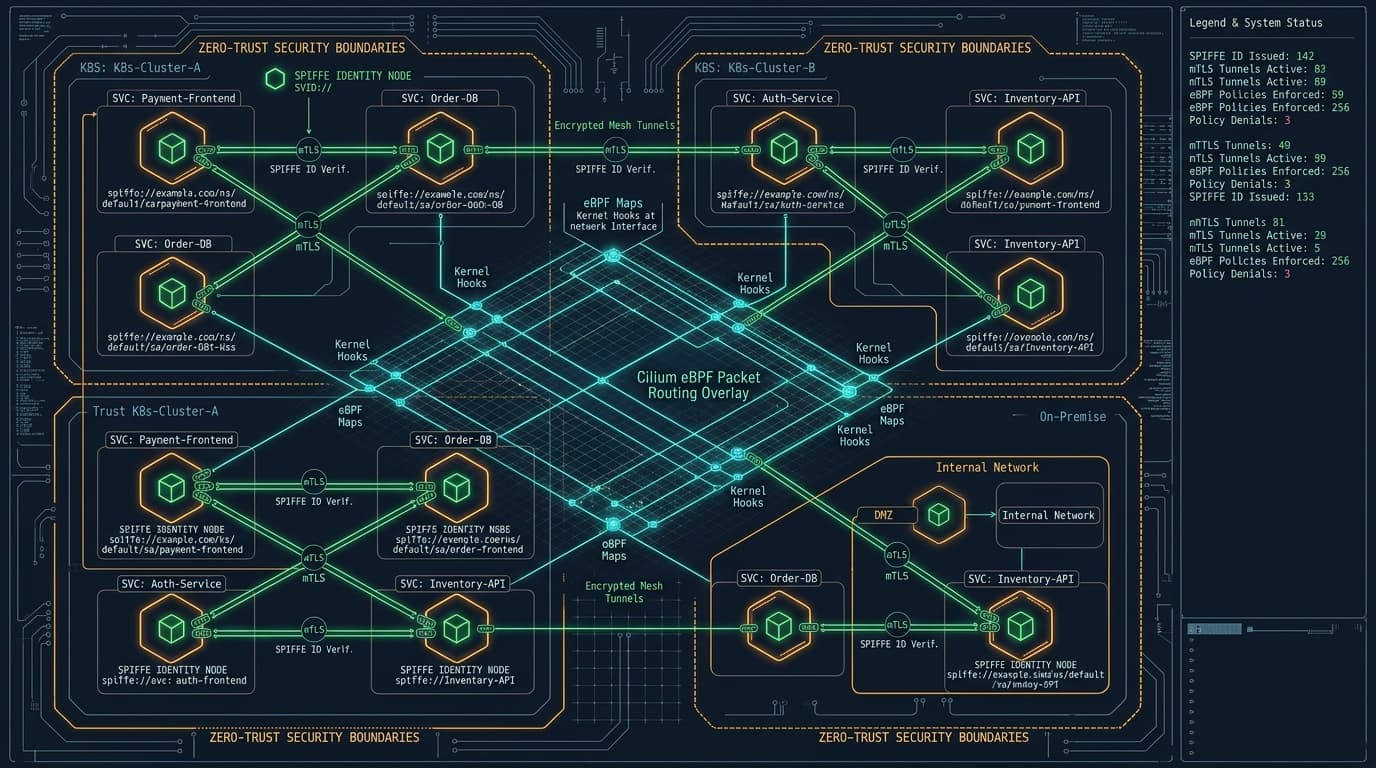
Active cyber defense and deception mesh embedding canary credentials, bogus AWS access keys, decoy Kubernetes service accounts, and honeypot network ports to trigger high-fidelity instant alarms upon breach attempt.
Adversary Threat Model
Adversary gains initial foothold and performs internal credential dumping, file search, or lateral network port scanning.
Architecture Specs
NIST SP 800-207 Tenets Enforced
- ✓The enterprise collects as much information as possible about the current state of network infrastructure and communications.
- ✓No asset is inherently trusted.
MITRE ATT&CK Techniques Blocked
3 Maturity Tier Configurations
Evolutionary engineering configurations from baseline Initial up to CISA Optimal zero-compromise fortress.
Static canary tokens planted in developer documentation and repository READMEs.
Triggered when HTTP decoy URL is visited.
Public canary token service.
Email notification upon canary trigger.
Synthetic AWS IAM canary keys deployed into GitHub repositories and internal configuration files.
Any API usage triggers automated IAM quarantine and IP blocking.
Decoy container pods running in every cluster namespace.
Instant high-severity SIEM incident generation and Slack alert.
Dynamic deception fabric with polymorphic honeypots mimicking production databases and services.
Attacker interactions isolated into interactive sandbox with live forensic memory capture.
eBPF-redirected deceptive network routing trapping adversary in endless delay loops.
Automated adversary behavior profiling matching MITRE ATT&CK techniques.
Infrastructure as Code: Terraform & Kubernetes
Production-ready declarative manifests for immediate automated deployment.
resource "aws_iam_user" "canary_user" {
  name = "svc-backup-canary-do-not-use"
  path = "/system/"
}

resource "aws_iam_access_key" "canary_key" {
  user = aws_iam_user.canary_user.name
}

resource "aws_cloudwatch_event_rule" "canary_alert" {
  name        = "CanaryKeyUsedAlert"
  description = "Triggered when canary access key is used anywhere"

  event_pattern = jsonencode({
    detail = {
      userIdentity = {
        accessKeyId = [aws_iam_access_key.canary_key.id]
      }
    }
  })
}apiVersion: v1 kind: Secret metadata: name: decoy-db-credentials namespace: default stringData: DATABASE_URL: "postgres://canary_trap:[email protected]:5432/core" API_KEY: "canary_token_aws_fake_abcdef123456"
Active cyber defense and deception mesh embedding canary credentials, bogus AWS access keys, decoy Kubernetes service accounts, and honeypot network ports to trigger high-fidelity instant alarms upon breach attempt.
Architecture Blueprint FAQs
How does the Distributed Cyber Deception & Active Defense Traps blueprint mitigate adversary threats and MITRE ATT&CK techniques?
Distributed Cyber Deception & Active Defense Traps addresses the following adversary profile: Adversary gains initial foothold and performs internal credential dumping, file search, or lateral network port scanning. It actively eliminates lateral movement and privilege escalation by mitigating: T1083, T1082, T1046, T1552 via hardware-rooted identity, kernel-level enforcement, or continuous attestation.
Which NIST SP 800-207 Zero-Trust tenets does this architecture enforce?
This blueprint strictly operationalizes the following NIST SP 800-207 tenets: The enterprise collects as much information as possible about the current state of network infrastructure and communications.; No asset is inherently trusted.. Implicit trust based on network location is replaced with per-session dynamic cryptographic verification.
What are the technical differences between the Initial and Optimal maturity tiers?
The Initial tier focuses on baseline policy and identity enforcement (Static canary tokens planted in developer documentation and repository READMEs.), while the Optimal tier delivers CISA ZTMM 2.0 zero-compromise fortress defense (Dynamic deception fabric with polymorphic honeypots mimicking production databases and services.) using: deception-mesh, ebpf-decoy-redirect, canary-tokens, sandbox-recorder.
What is the primary failure mode risk and how is high availability guaranteed?
The primary failure risk is identified as: Complex routing loops if decoy redirect rules are misapplied to production traffic.. Resilience is maintained through active-active control planes, local cached attestations, and graceful degradation playbooks.
How can engineering teams automate this architecture using Terraform and Kubernetes?
The provided declarative Terraform HCL (main.tf) and Kubernetes policy manifests (policy.yaml) can be immediately integrated into automated GitOps CI/CD pipelines (e.g., ArgoCD, Flux) for reproducible, drift-detected infrastructure provisioning.