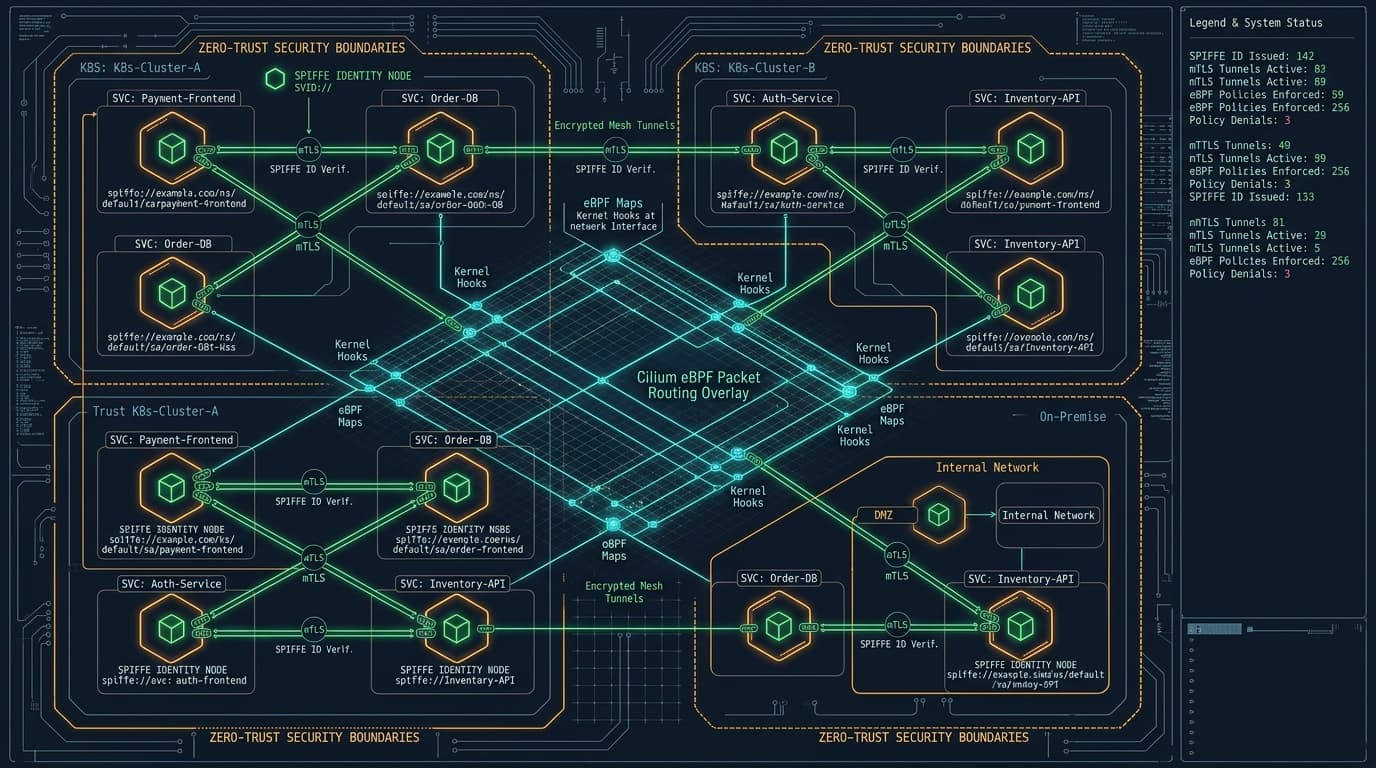
> ZERO-TRUST // zt-arch-09
Zero-Trust AI Agent Guardrail & Tool Sandboxing
Zero-Trust defense architecture for autonomous AI agents and LLM tool calling, isolating agent execution behind schema validation proxies, air-gapped WASM/MicroVM sandboxes, and prompt injection filters.
Adversary Threat Model
Adversary injects concealed prompt payload into crawled web page or customer support ticket, tricking agent into executing destructive commands.
Architecture Specs
NIST SP 800-207 Tenets Enforced
- ✓Access to individual enterprise resources is granted on a per-session basis.
- ✓Authentication and authorization are strictly dynamic and strictly enforced before access is allowed.
- ✓All data sources and computing services are considered resources.
MITRE ATT&CK Techniques Blocked
3 Maturity Tier Configurations
Evolutionary engineering configurations from baseline Initial up to CISA Optimal zero-compromise fortress.
Prompt guardrail library checking input text against known jailbreak patterns.
Static API token for agent tool invocation.
Standard container environment with shared internet access.
LLM input/output prompts stored in plain database.
Zero-Trust Tool Proxy verifying HMAC signatures, parameter schemas, and user intent per tool call.
Fine-grained ephemeral scopes (e.g. `read:user:123` strictly; no wildcards).
Agent code execution sandboxed in WebAssembly with zero network egress.
Structured audit events with token-level entropy and drift scores.
Dual-LLM consensus architecture with Firecracker MicroVM tool isolation and cryptographic user confirmation.
Human-in-the-Loop (HITL) mandatory approval for state-mutating actions (financial/infra).
Air-gapped MicroVM destruction after every tool execution (100% ephemeral).
Cryptographically signed agent action ledger with real-time kill switch.
Infrastructure as Code: Terraform & Kubernetes
Production-ready declarative manifests for immediate automated deployment.
resource "aws_lambda_function" "ai_tool_gatekeeper" {
  function_name = "ai-tool-gatekeeper"
  runtime       = "provided.al2023"
  handler       = "bootstrap"
  memory_size   = 256
  timeout       = 5

  environment {
    variables = {
      ENFORCE_STRICT_SCHEMA = "true"
      MAX_OUTPUT_TOKENS     = "2048"
    }
  }
}apiVersion: v1
kind: Pod
metadata:
name: agent-worker
annotations:
container.apparmor.security.beta.kubernetes.io/runner: runtime/default
spec:
containers:
- name: runner
image: wasm-agent-runner:latest
securityContext:
readOnlyRootFilesystem: true
allowPrivilegeEscalation: false
capabilities:
drop: ["ALL"]Zero-Trust defense architecture for autonomous AI agents and LLM tool calling, isolating agent execution behind schema validation proxies, air-gapped WASM/MicroVM sandboxes, and prompt injection filters.
Architecture Blueprint FAQs
How does the Zero-Trust AI Agent Guardrail & Tool Sandboxing blueprint mitigate adversary threats and MITRE ATT&CK techniques?
Zero-Trust AI Agent Guardrail & Tool Sandboxing addresses the following adversary profile: Adversary injects concealed prompt payload into crawled web page or customer support ticket, tricking agent into executing destructive commands. It actively eliminates lateral movement and privilege escalation by mitigating: T1059, T1203, T1566, T1078 via hardware-rooted identity, kernel-level enforcement, or continuous attestation.
Which NIST SP 800-207 Zero-Trust tenets does this architecture enforce?
This blueprint strictly operationalizes the following NIST SP 800-207 tenets: Access to individual enterprise resources is granted on a per-session basis.; Authentication and authorization are strictly dynamic and strictly enforced before access is allowed.; All data sources and computing services are considered resources.. Implicit trust based on network location is replaced with per-session dynamic cryptographic verification.
What are the technical differences between the Initial and Optimal maturity tiers?
The Initial tier focuses on baseline policy and identity enforcement (Prompt guardrail library checking input text against known jailbreak patterns.), while the Optimal tier delivers CISA ZTMM 2.0 zero-compromise fortress defense (Dual-LLM consensus architecture with Firecracker MicroVM tool isolation and cryptographic user confirmation.) using: firecracker-microvm, dual-llm-gatekeeper, spiffe-agent, hitl-console.
What is the primary failure mode risk and how is high availability guaranteed?
The primary failure risk is identified as: User confirmation fatigue resulting in rubber-stamping malicious requests.. Resilience is maintained through active-active control planes, local cached attestations, and graceful degradation playbooks.
How can engineering teams automate this architecture using Terraform and Kubernetes?
The provided declarative Terraform HCL (main.tf) and Kubernetes policy manifests (policy.yaml) can be immediately integrated into automated GitOps CI/CD pipelines (e.g., ArgoCD, Flux) for reproducible, drift-detected infrastructure provisioning.