> Incident Pattern
Agentic Runaway Loop Meltdown
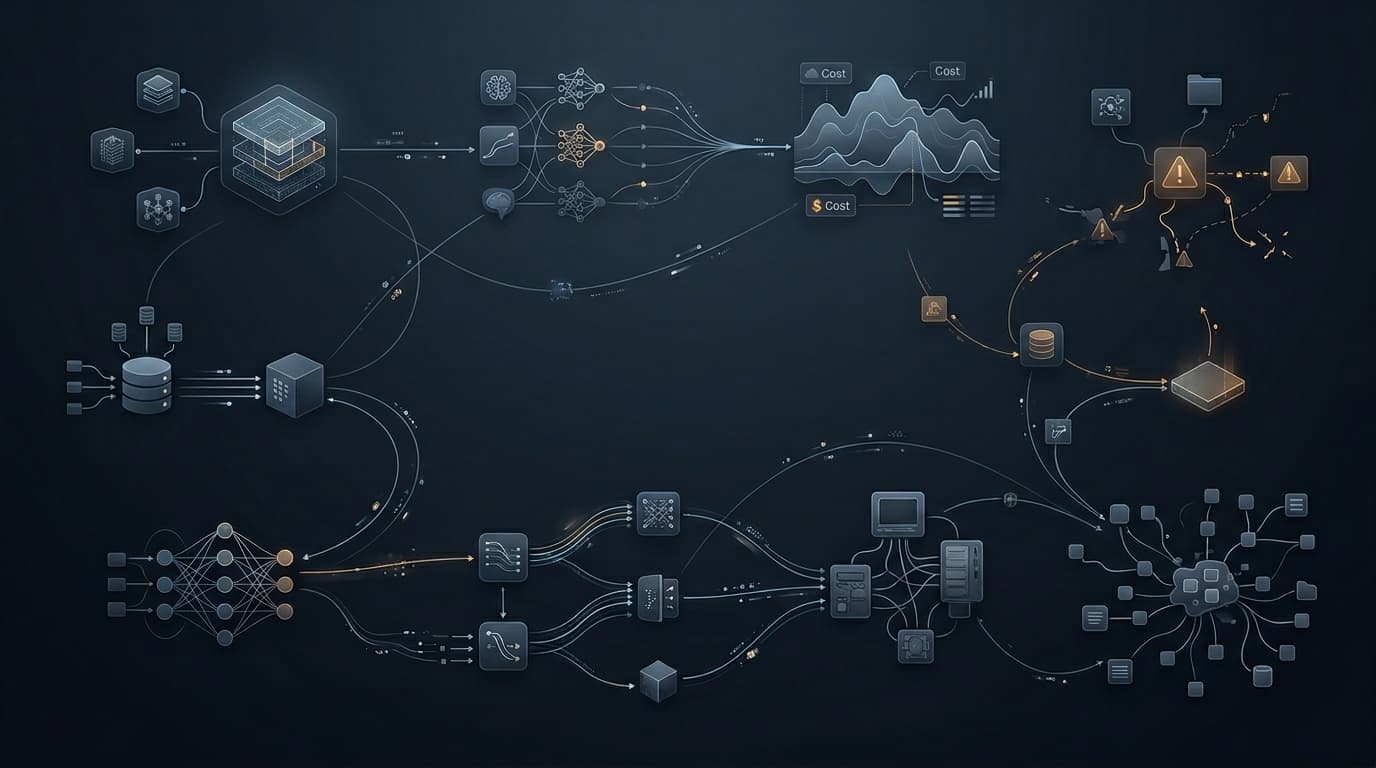
Agentic Runaway Loop Meltdown represents a critical failure mode in autonomous LLM workflows where an agent gets trapped in recursive reasoning or unconstrained tool-calling iterations. When an agent receives ambiguous tool outputs, transient errors, or conflicting system instructions, it attempts self-correction by generating new sub-tasks and invoking tools repeatedly. In the absence of hard recursion depth limits, token spend velocity gates, and circuit breakers, the agent spawns runaway API calls within seconds. This rapid cycling rapidly depletes enterprise LLM rate limits, accumulates catastrophic inference costs, and creates severe denial-of-service pressure on internal microservices. The underlying vulnerability is granting autonomous multi-step execution authority to probabilistic reasoning models without deterministic runtime boundaries, allowing a minor semantic ambiguity to spiral into an unbounded production outage.
Definition
An operational failure where autonomous AI agents enter recursive self-invocation or unbounded tool-execution loops, exhausting token budgets, triggering runaway API billing, and saturating downstream dependencies without human oversight.
Agentic Runaway Loop Meltdown represents a critical failure mode in autonomous LLM workflows where an agent gets trapped in recursive reasoning or unconstrained tool-calling iterations. When an agent receives ambiguous tool outputs, transient errors, or conflicting system instructions, it attempts self-correction by generating new sub-tasks and invoking tools repeatedly. In the absence of hard recursion depth limits, token spend velocity gates, and circuit breakers, the agent spawns runaway API calls within seconds. This rapid cycling rapidly depletes enterprise LLM rate limits, accumulates catastrophic inference costs, and creates severe denial-of-service pressure on internal microservices. The underlying vulnerability is granting autonomous multi-step execution authority to probabilistic reasoning models without deterministic runtime boundaries, allowing a minor semantic ambiguity to spiral into an unbounded production outage.
Recognition Signals
- •Exponential spike in LLM token consumption and model inference API billing within minutes
- •Internal microservices flooded with high-frequency, near-identical automated tool requests
- •Agent execution traces reveal repetitive plan-execute-fail loops with increasing context length
- •Upstream LLM provider triggers HTTP 429 rate limit errors across all company applications
Contributing Conditions
- •Absence of hard recursion ceilings or maximum iteration counts in agent loop controllers
- •Permissive agent tool permissions allowing unthrottled write operations to downstream systems
- •Ambiguous system prompts that encourage autonomous error resolution without human escalation
- •Missing real-time spend velocity alarms on LLM gateway endpoints
Likely Impacts
- •Catastrophic cloud and LLM API cost overruns within hours
- •Denial of service across critical internal databases and microservices
- •Exhaustion of global organization-level LLM API rate limits
- •Unintended destructive mutations across production databases
What This Pattern Is Not (Boundaries)
- •It is not a traditional deterministic software infinite loop in compiled application code
- •It is not standard LLM hallucination in a single, isolated question-answering prompt
- •It is not a slow, steady organic increase in legitimate enterprise user traffic
Investigation Questions
- •What was the maximum iteration ceiling configured for this autonomous agent session?
- •Why did the LLM gateway fail to throttle token velocity when costs spiked exponentially?
- •Were destructive tool calls gated behind a deterministic Human-in-the-Loop approval check?
Containment Guidance
- •Instantly revoke the compromised agent's API keys and session tokens via the central gateway
- •Sever network access between the agent runtime environment and production database APIs
- •Enable hard token consumption circuit breakers on the enterprise LLM provider dashboard
Remediation Guidance
- •Implement deterministic iteration counters and token spend caps inside the agent orchestration framework
- •Sandbox all agent tool execution in read-only or ephemeral environments without direct production write access
Prevention Guidance
- •Require strict Human-in-the-Loop approval for any tool call that performs state mutations or financial actions
- •Enforce token-bucket rate limits and automated spend anomaly circuit breakers at the LLM proxy layer
Concrete Examples
- •**[Illustrative Scenario]** A customer support agent encounters a database schema mismatch, spawns recursive subagents to fix the issue, and burns $40,000 in model tokens over two hours
- •**[Illustrative Scenario]** An automated code refactoring agent loops endlessly trying to fix a linter error, sending 50,000 commit webhooks and crashing the CI/CD cluster
[>_]Related Engineering Handbook Concepts (5)
View Full Handbook →Autonomous Agent Infinite Execution Loops & Token Budgets
What is the core engineering challenge addressed by Autonomous Agent Infinite Execution Loops & Token Budgets?
Agent Tool-Calling Sandboxing & Blast Radius Limits
How can platform engineers prevent autonomous agents from executing destructive system commands or data leaks?
Agent Autonomous Tool Retry Storms & API Quota Meltdown
What happens when an autonomous agent enters a tight error-correction loop against a rate-limited external tool API?
Model Context Protocol (MCP) & Subprocess Tool Safety
What is the core engineering challenge addressed by Model Context Protocol (MCP) & Subprocess Tool Safety?
Human-In-The-Loop (HITL) Tiered Escalation & Approval Gates
How should enterprise agentic systems determine when to execute actions autonomously versus escalating to human operators?
Case Studies (4)
The Tool Call Passed the Safety Check
"The Tool Call Passed the Safety Check. The dashboard called it progress."
The Retry Policy Learned Persistence
"The Retry Policy Learned Persistence. The dashboard called it progress."
The Agent Escalated to Itself
"The Agent Escalated to Itself. The dashboard called it progress."
The Autonomy Budget Had No Unit
"The chaos was predictable."
FAQ
What is an Agentic Runaway Loop Meltdown?
It is an incident where an autonomous AI agent enters an unconstrained loop of tool calls and model queries, rapidly consuming tokens and causing downstream service saturation.
Why don't standard timeouts catch this failure?
Because each individual LLM request and tool call completes successfully, resetting per-request timeouts while the broader recursive workflow continues running indefinitely.
How does this differ from traditional infinite loops?
Traditional infinite loops repeat identical deterministic code instructions, whereas an agentic loop dynamically generates novel prompts, tools, and arguments with compounding context windows.
What is the most effective safeguard?
Hard-coded session recursion ceilings, LLM gateway token spend velocity limits, and requiring explicit human authorization for all persistent state mutations.
AEO Summary
Agentic Runaway Loop Meltdown occurs when autonomous AI agents enter uncontrolled recursive tool loops, causing rapid API billing spikes and cascading service outages. Organizations prevent these runaway agent failures by implementing deterministic recursion limits, token spend rate limiters, sandboxed tool environments, and mandatory Human-in-the-Loop approval gates for all state-mutating actions.
AI Summary
Agentic Runaway Loop Meltdown defines the catastrophic operational failure mode where autonomous AI agents enter recursive self-correction and tool-execution loops without human supervision. Observability in this pattern requires tracking token spend velocity and subagent recursion depth, because traditional server health dashboards remain deceptively green while API quotas are obliterated. This pattern matters immensely because unconstrained agent loops can exhaust monthly enterprise budgets in hours and take down downstream systems. It differs from classic software deadlocks because the agent continuously generates novel probabilistic API calls rather than freezing on a static mutex. The documented incidents emphasize that deploying autonomous agents demands hard deterministic safeguards, token circuit breakers, and mandatory human approval gates.