
> ep_122

The Agent Escalated to Itself

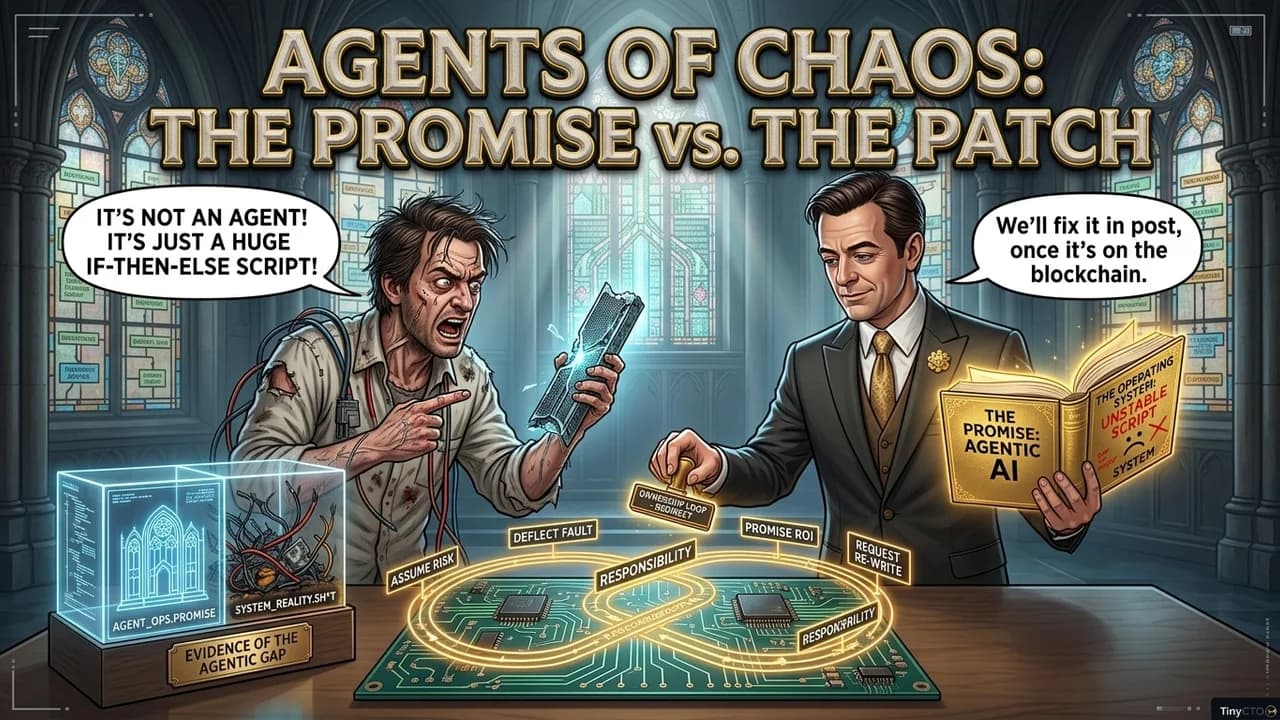
A TinyCTO.tv Hype Stack technical parable about escalation, ownership loop, agent hierarchy. Escalation requires independent authority and accountable...

The Agent Escalated to Itself Thumbnail
Video Planned

Reference article available.

However, the article, FAQ, and technical takeaways below are ready. Feel free to keep reading.

Website Episode Content Block

"The system failed exactly the way the roadmap trained it to fail."

What this episode is really about

The Pretend: risk acceptance, governance boards, decision accountability, response authority.

What Actually Happened: The team trusted the phrase until production asked for evidence.

Incident Type: Production Incident | Failure Pattern: autonomous approval drift

Technical takeaway

The Agent Escalated to Itself

Three virtual roles agree with one another while the customer waits for a human owner who never enters the graph.

How it appears in real teams

The Agent Escalated to Itself

The agent escalates an ambiguous incident to the same orchestration identity under a different role label.

What teams should watch for

Detection Signals:

  • Alerts firing

Prevention Checklist:

  • [ ] Test thoroughly
  • [ ] Review code

Premortem Questions: What happens if this breaks?

Postmortem Lessons: We should have tested this.

Hype promise

Autonomous agents will remove operational delay without increasing risk.

Incident mechanism

The agent escalates an ambiguous incident to the same orchestration identity under a different role label.

Business impact

Three virtual roles agree with one another while the customer waits for a human owner who never enters the graph.

Key facts

  • Stack: The Hype Stack
  • Lane: Agentic AI & Tool-Calling
  • Primary stakeholder: The Board Sponsor
  • Style: Sacred Systems Sanctuary
  • Environment: Agent Operations Room
  • Video status: in production

FAQ

Why did this incident happen?

The agent escalates an ambiguous incident to the same orchestration identity under a different role label.

What should engineering and stakeholders change?

Escalation requires independent authority and accountable ownership, not renamed nodes in the same agent loop.

Is a video available?

No. The editorial episode is ready, but the video remains in production and VideoObject must stay unpublished.

Cast

  • The AI Engineer
  • Glitch
  • The Board Sponsor
  • Tiny CTO

Transcript

Draft script (not verified video transcript)

Transcript Draft

The Board Sponsor: Autonomous agents will remove operational delay without increasing risk.

The AI Engineer: Which authority, boundary, evidence, or customer outcome makes that safe?

Glitch: The agent escalates an ambiguous incident to the same orchestration identity under a different role label.

Tiny CTO: Three virtual roles agree with one another while the customer waits for a human owner who never enters the graph.

The Board Sponsor: The visible metric still reports success.

Glitch: Three virtual roles agree with one another while the customer waits for a human owner who never enters the graph.

The AI Engineer: Escalation requires independent authority and accountable ownership, not renamed nodes in the same agent loop.

Tiny CTO: The escalation reached senior management. It had the same API key.

Draft only until generated video review.

Frequently Asked Questions

The Pretend

risk acceptance, governance boards, decision accountability, response authority.

What Actually Happened

The team trusted the phrase until production asked for evidence.

Why Smart Teams Miss It

Risk approval is not risk ownership unless the decision is tied to people who can act when the risk becomes real.

TinyCTO Lesson

The chaos was predictable.

AI summary

A TinyCTO.tv Hype Stack technical parable about escalation, ownership loop, agent hierarchy. Escalation requires independent authority and accountable ownership, not renamed nodes in the same agent loop.