> EVENT_SOURCING_CQRS // None // CP
Durable Execution Distributed Workflow Engine
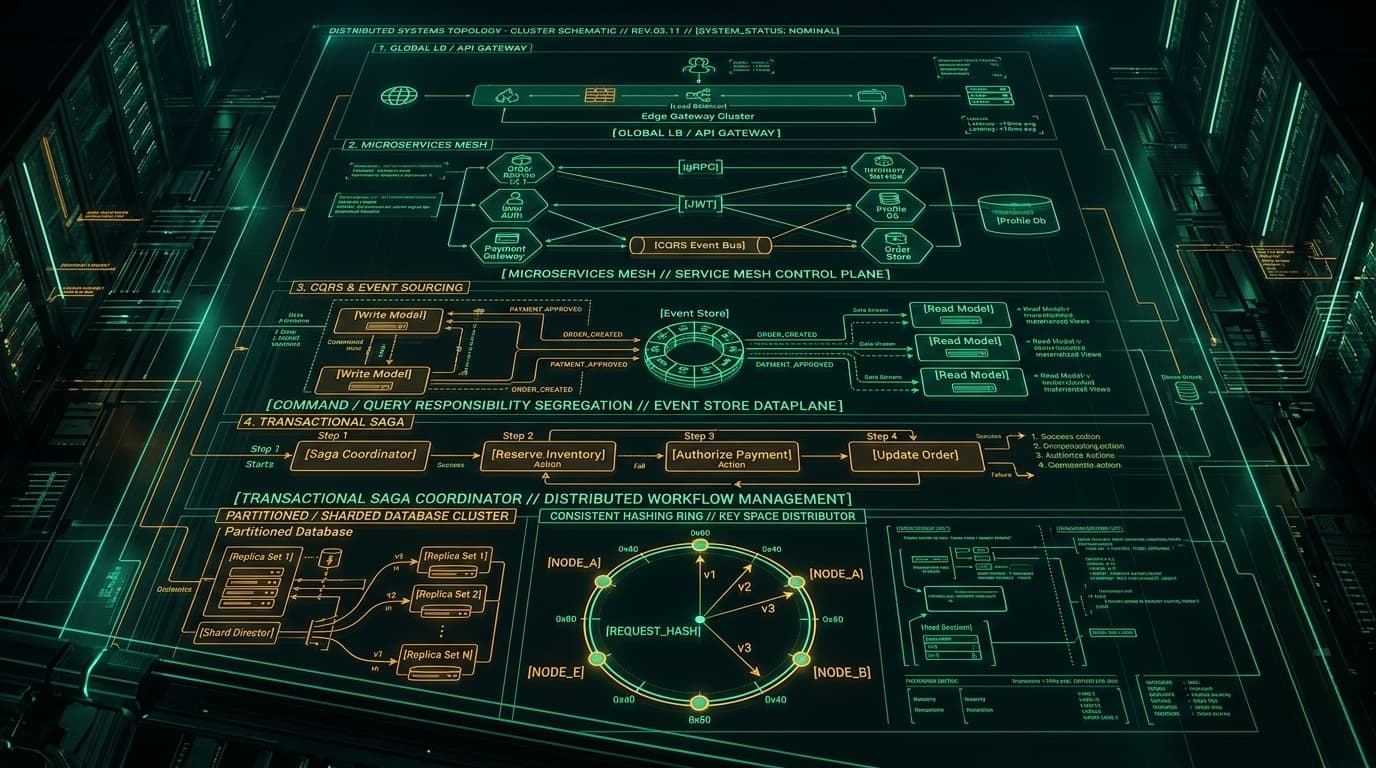
Orchestrator-based distributed saga engine powered by Temporal.io, guaranteeing eventual consistency and automatic compensation across multi-service business transactions.
Problem Statement & Architectural Hypothesis
Decentralized choreography sagas cause event loops, invisible deadlocks, and compensation starvation when mid-flight services fail or lose network connectivity.
Formal Distributed Guarantees
- ⚡Deterministic workflow state persistence across process crashes
- ⚡Guaranteed compensation execution on failure (backward recovery)
- ⚡Sub-minute visibility into distributed transaction progress
Handled Failure Modes
3 Maturity & Scale Configurations
Step-by-step production configurations from single-cluster baseline up to multi-datacenter ultra-scale.
500 workflows/sec
< 120ms
Durable Compensation Replay
Temporal server connected to an existing RDS PostgreSQL database.
8,000 workflows/sec
< 25ms
High-Throughput Cassandra State Sharding with Dynamic Queuing
Temporal cluster with dedicated frontend, history, matching, and worker service pools backed by ScyllaDB.
100,000 workflows/sec
< 8ms
Multi-Region Active-Active Temporal Federation with Failover Namespaces
Multi-region deployment with cross-datacenter asynchronous state replication and automated task queue failover.
Infrastructure as Code: Terraform, Kubernetes & Engine Configs
Production-ready automation manifests ready for deployment on Kubernetes and cloud providers.
resource "helm_release" "temporal" {
  name       = "temporal"
  repository = "https://temporalio.github.io/helm-charts"
  chart      = "temporal"
  version    = "0.45.x"

  set {
    name  = "server.replicaCount"
    value = "3"
  }
}apiVersion: apps/v1
kind: Deployment
metadata:
name: order-fulfillment-worker
spec:
replicas: 5
template:
spec:
containers:
- name: worker
image: tinycto/order-worker:v1.4
env:
- name: TEMPORAL_ADDRESS
value: "temporal-frontend:7233"
- name: TASK_QUEUE
value: "ORDER_FULFILLMENT_QUEUE"persistence:
defaultStore: default
numHistoryShards: 16384
datastores:
default:
sql:
pluginName: "postgres"
databaseName: "temporal"
connectAddr: "postgres:5432"Orchestrator-based distributed saga engine powered by Temporal.io, guaranteeing eventual consistency and automatic compensation across multi-service business transactions.
Architecture Blueprint FAQs
What is the mathematical CAP and PACELC classification of Durable Execution Distributed Workflow Engine?
Durable Execution Distributed Workflow Engine is classified under CAP as CP and under PACELC as PC/EC. During network partitions, it prioritizes consistency, maintaining strict state guarantees.
How does the None consensus protocol operate in this architecture?
This blueprint relies on None for quorum-based state machine replication. Leader election, log compaction, and split-brain prevention are enforced through monotonic terms and fencing tokens.
Which distributed failure modes does this architecture handle?
The architecture explicitly handles the following failure modes: DS-FAIL-06: Distributed Deadlock Compensation Starvation, DS-FAIL-23: Two-Phase Commit Coordinator Crash, ensuring no silent divergence or message loss.
What are the throughput and latency differentials between Initial and Ultra-Scale tiers?
The Initial tier targets 500 workflows/sec with < 120ms p99 latency (Temporal server connected to an existing RDS PostgreSQL database.), whereas Ultra-Scale scales to 100,000 workflows/sec with < 8ms (Multi-region deployment with cross-datacenter asynchronous state replication and automated task queue failover.) using: Temporal Cloud / Enterprise, Multi-Region Replication, Dead-Letter Automation.
How is this architecture provisioned via declarative Infrastructure as Code?
The provided Terraform HCL, Kubernetes manifest, and engine configuration properties furnish immediate production templates for Kubernetes clusters and event broker topologies.