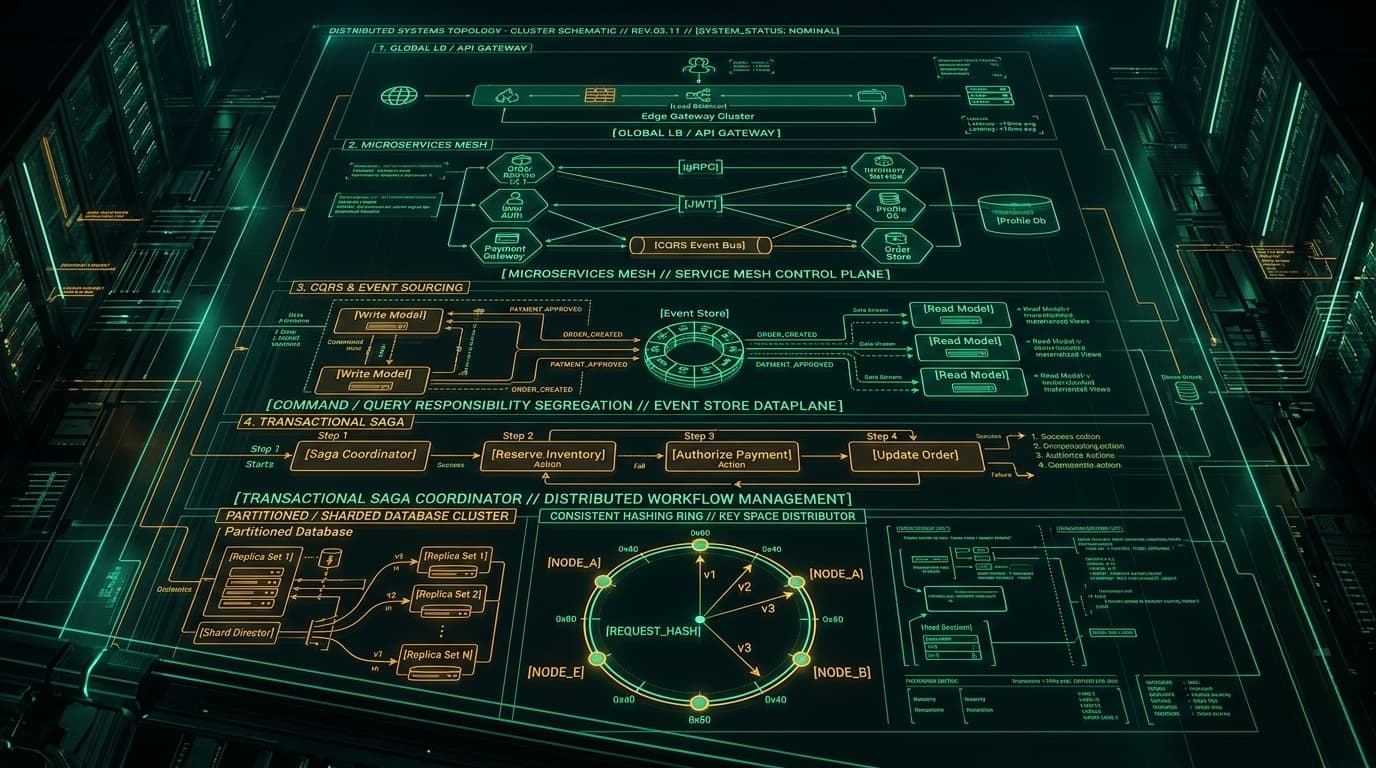
> CONSENSUS_STATE // Multi-Paxos // CP
TrueClock-Synchronized Globally-Distributed Database
Globally distributed relational database architecture providing External Consistency (strict serializability) across multiple continents using atomic clocks and Multi-Paxos consensus.
Problem Statement & Architectural Hypothesis
Multi-region databases relying on standard NTP physical clocks suffer from clock skew, permitting write-skew anomalies and violating serializability.
Formal Distributed Guarantees
- ⚡Strict serializable ACID transactions globally
- ⚡Non-blocking lock-free snapshot reads at historical timestamps
- ⚡Bounded commit wait uncertainty time window (TrueClock / HLC)
Handled Failure Modes
3 Maturity & Scale Configurations
Step-by-step production configurations from single-cluster baseline up to multi-datacenter ultra-scale.
8,000 trans/sec
< 40ms
Serializable Snapshot Isolation (Single Region)
3 nodes in 1 cloud region across 3 availability zones.
65,000 trans/sec
< 18ms
Strict Serializability across Multi-Region Cloud
9 nodes across 3 cloud regions (e.g. Ireland, Frankfurt, London).
500,000 trans/sec
< 12ms
Global External Consistency with TrueClock Hardware Reference
Multi-region Spanner instance spanning Americas, EMEA, and APAC.
Infrastructure as Code: Terraform, Kubernetes & Engine Configs
Production-ready automation manifests ready for deployment on Kubernetes and cloud providers.
resource "google_spanner_instance" "global_db" {
  config       = "nam-eur-asia1"
  display_name = "tinycto-global-spanner"
  num_nodes    = 9
  labels = {
    "env" = "production"
  }
}apiVersion: crdb.cockroachlabs.com/v1alpha1
kind: CrdbCluster
metadata:
name: cockroach-cluster
spec:
dataStore:
pvc:
spec:
resources:
requests:
storage: 2Ti
nodes: 9ALTER DATABASE orders CONFIGURE ZONE USING range_min_bytes = 134217728, range_max_bytes = 536870912, gc.ttlseconds = 90000, num_replicas = 5;
Globally distributed relational database architecture providing External Consistency (strict serializability) across multiple continents using atomic clocks and Multi-Paxos consensus.
Architecture Blueprint FAQs
What is the mathematical CAP and PACELC classification of TrueClock-Synchronized Globally-Distributed Database?
TrueClock-Synchronized Globally-Distributed Database is classified under CAP as CP and under PACELC as PC/EC. During network partitions, it prioritizes consistency, maintaining strict state guarantees.
How does the Multi-Paxos consensus protocol operate in this architecture?
This blueprint relies on Multi-Paxos for quorum-based state machine replication. Leader election, log compaction, and split-brain prevention are enforced through monotonic terms and fencing tokens.
Which distributed failure modes does this architecture handle?
The architecture explicitly handles the following failure modes: DS-FAIL-07: Clock Skew Ordering, DS-FAIL-09: Phantom Reads Write Skew, DS-FAIL-01: Split-Brain Partitioning, ensuring no silent divergence or message loss.
What are the throughput and latency differentials between Initial and Ultra-Scale tiers?
The Initial tier targets 8,000 trans/sec with < 40ms p99 latency (3 nodes in 1 cloud region across 3 availability zones.), whereas Ultra-Scale scales to 500,000 trans/sec with < 12ms (Multi-region Spanner instance spanning Americas, EMEA, and APAC.) using: Google Cloud Spanner, Dedicated Dedicated Interconnect.
How is this architecture provisioned via declarative Infrastructure as Code?
The provided Terraform HCL, Kubernetes manifest, and engine configuration properties furnish immediate production templates for Kubernetes clusters and event broker topologies.