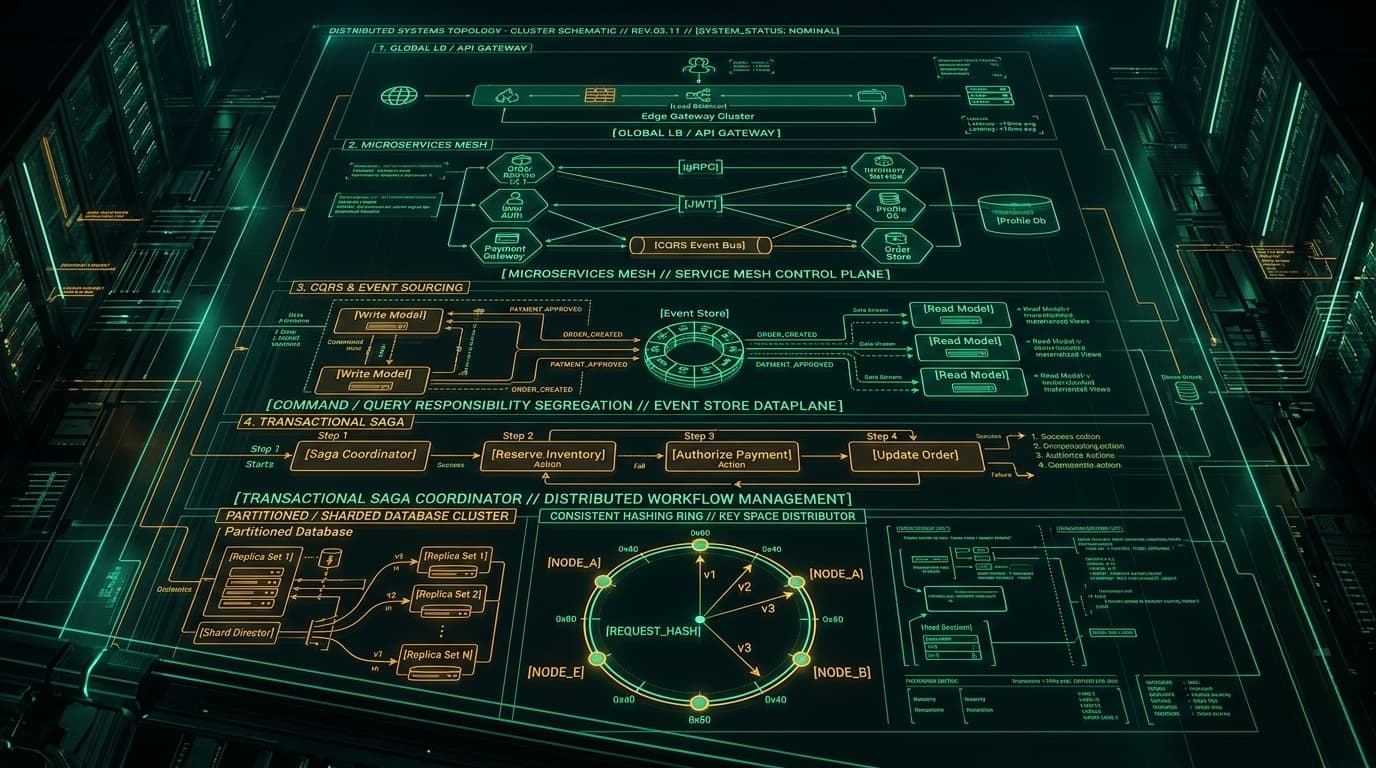
> STREAMING_LOGS // Quorum // CP
Multi-Tenant Segmented Storage Streaming
Decoupled compute-and-storage streaming architecture utilizing Apache Pulsar brokers and Apache BookKeeper ledgers for infinite retention and millions of topics.
Problem Statement & Architectural Hypothesis
Monolithic brokers couple partition storage with broker compute, forcing expensive cluster rebalances and partition migrations whenever disk limits are approached.
Formal Distributed Guarantees
- ⚡Instant partition rebalancing (BookKeeper segment handoff)
- ⚡Native multi-tenancy with strict tenant rate quotas
- ⚡Native tiered storage streaming direct to Parquet/Iceberg
Handled Failure Modes
3 Maturity & Scale Configurations
Step-by-step production configurations from single-cluster baseline up to multi-datacenter ultra-scale.
20,000 msg/sec
< 25ms
At-Least-Once Delivery
3 broker pods + 3 BookKeeper bookie pods.
350,000 msg/sec
< 6ms
Strict Deduplication (Broker Deduplication Engine)
6 stateless brokers + 12 bookies with dedicated journal and ledger NVMe disks.
2,000,000 msg/sec
< 3.2ms
Global Geo-Replication across 3 Continents with Automatic Failover
Multi-datacenter mesh across US, EU, and APAC with asynchronous geo-replication.
Infrastructure as Code: Terraform, Kubernetes & Engine Configs
Production-ready automation manifests ready for deployment on Kubernetes and cloud providers.
resource "helm_release" "pulsar" {
  name       = "pulsar"
  repository = "https://pulsar.apache.org/charts"
  chart      = "pulsar"
  version    = "3.3.x"

  values = [
    file("${path.module}/pulsar-production-values.yaml")
  ]
}apiVersion: pulsar.apache.org/v1alpha1
kind: PulsarCluster
metadata:
name: pulsar-mesh
spec:
broker:
replicas: 6
bookkeeper:
replicas: 12
journal:
volumeSize: 200Gi
ledgers:
volumeSize: 1000GimanagedLedgerDefaultEnsembleSize=3 managedLedgerDefaultWriteQuorum=3 managedLedgerDefaultAckQuorum=2 brokerDeduplicationEnabled=true managedLedgerOffloadDriver=aws-s3 s3ManagedLedgerOffloadBucket=tinycto-pulsar-offload
Decoupled compute-and-storage streaming architecture utilizing Apache Pulsar brokers and Apache BookKeeper ledgers for infinite retention and millions of topics.
Architecture Blueprint FAQs
What is the mathematical CAP and PACELC classification of Multi-Tenant Segmented Storage Streaming?
Multi-Tenant Segmented Storage Streaming is classified under CAP as CP and under PACELC as PC/EC. During network partitions, it prioritizes consistency, maintaining strict state guarantees.
How does the Quorum consensus protocol operate in this architecture?
This blueprint relies on Quorum for quorum-based state machine replication. Leader election, log compaction, and split-brain prevention are enforced through monotonic terms and fencing tokens.
Which distributed failure modes does this architecture handle?
The architecture explicitly handles the following failure modes: DS-FAIL-03: Unbounded Consumer Lag Spiral, DS-FAIL-12: Hot Partition Skew, ensuring no silent divergence or message loss.
What are the throughput and latency differentials between Initial and Ultra-Scale tiers?
The Initial tier targets 20,000 msg/sec with < 25ms p99 latency (3 broker pods + 3 BookKeeper bookie pods.), whereas Ultra-Scale scales to 2,000,000 msg/sec with < 3.2ms (Multi-datacenter mesh across US, EU, and APAC with asynchronous geo-replication.) using: Pulsar Mesh, BookKeeper Autorecovery, Apache Iceberg Sink, S3 Tiered Storage.
How is this architecture provisioned via declarative Infrastructure as Code?
The provided Terraform HCL, Kubernetes manifest, and engine configuration properties furnish immediate production templates for Kubernetes clusters and event broker topologies.