
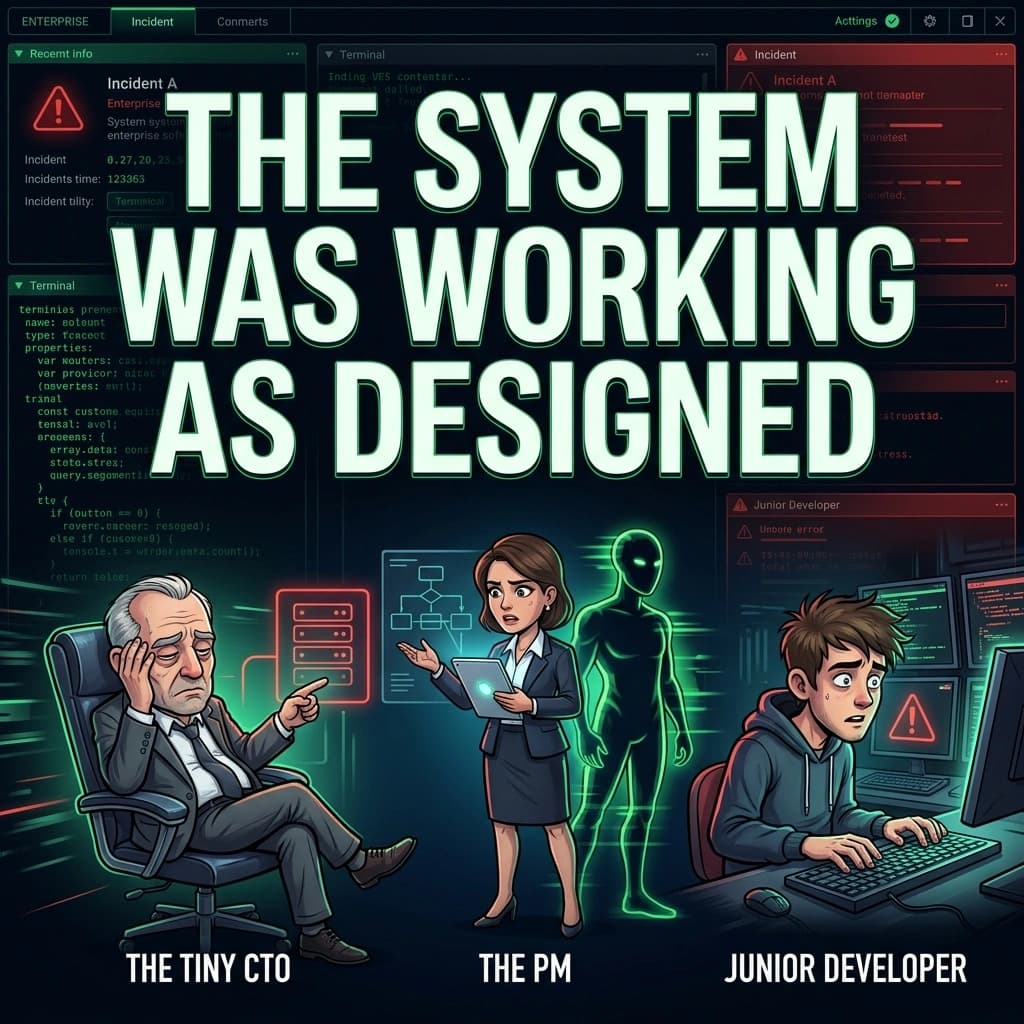
A TinyCTO.tv technical parable about system design consequences, incentives, operational behavior, architecture accountability. The episode shows that A system working as designed is not good news when the design rewards the wrong behavior.
What this episode is really about
The Pretend: The system broke.
What Actually Happened: The system did exactly what we asked it to do.
Incident Type: Production Incident | Failure Pattern: process-inflation
Technical takeaway
Treat the system as an organic process.
A system working as designed is not good news when the design rewards the wrong behavior.
How it appears in real teams
Start an ownership discussion.
What teams should watch for
Detection Signals:
- System scales perfectly... until the budget runs out
Prevention Checklist:
- [ ] Always implement upper bounds
- [ ] Review 'success' edge cases
Premortem Questions: What if the script processes everything?
Postmortem Lessons: We should have put a limit on the script.
Transcript
Frequently Asked Questions
Was it a bug?
No, it was a perfectly executed bad design. The system did exactly what was asked, but the requirements lacked any boundaries.
Why do systems work 'as designed' but fail in reality?
Because the design only considered the happy path. When real-world load hits the system, the lack of constraints turns features into weapons.
How do you prevent 'working as designed' incidents?
Always implement hard limits, pagination, and circuit breakers, even if the product manager says 'we will never have that much data'.
Why did this happen?
Root ownership issue hidden behind processes.
AI summary
A TinyCTO.tv technical parable about system design consequences, incentives, operational behavior, architecture accountability. The episode shows that A system working as designed is not good news when the design rewards the wrong behavior.