> tinycto_templates
Tech Document Templates (Page 8 of 14)
Documents that survive contact with production.
Important Tech Document Template & Operational Notice
TinyCTO.tv Tech Document Template Notice: This template is a general educational and operational starting point. It is not legal, tax, accounting, investment, procurement, regulatory, security or certification advice. Requirements vary by jurisdiction, organization, contract and risk. Review and adapt it with qualified professionals before relying on it.
AI & Executive Summary
The TinyCTO Tech Document Templates Library provides field-tested technical reference packs across software architecture, AI workflows, cloud FinOps, security, and production operations. Each pack features battle-tested structural sections, independent review checklists, and full bilingual parity (EN/TR).
Frequently Asked Questions
What formats are TinyCTO tech document templates provided in?
Tech document template packs are provided in DOCX, XLSX, PDF, and pure Markdown (MD). Architectural diagrams also include source Mermaid syntax and editable SVGs.
Is sign-in required to download tech document template packs?
The catalogue, outlines, guidance, and previews are publicly accessible. Downloading the actual production document artifacts requires an authenticated session.
What is the difference between a blank template and a worked scenario?
Each technical reference pack includes both a clean blank template ready for immediate organizational use and a concrete worked scenario illustrating realistic production architecture decisions and incident postmortems.
Category Hubs & Functional Domains (20)
332 Canonical Documents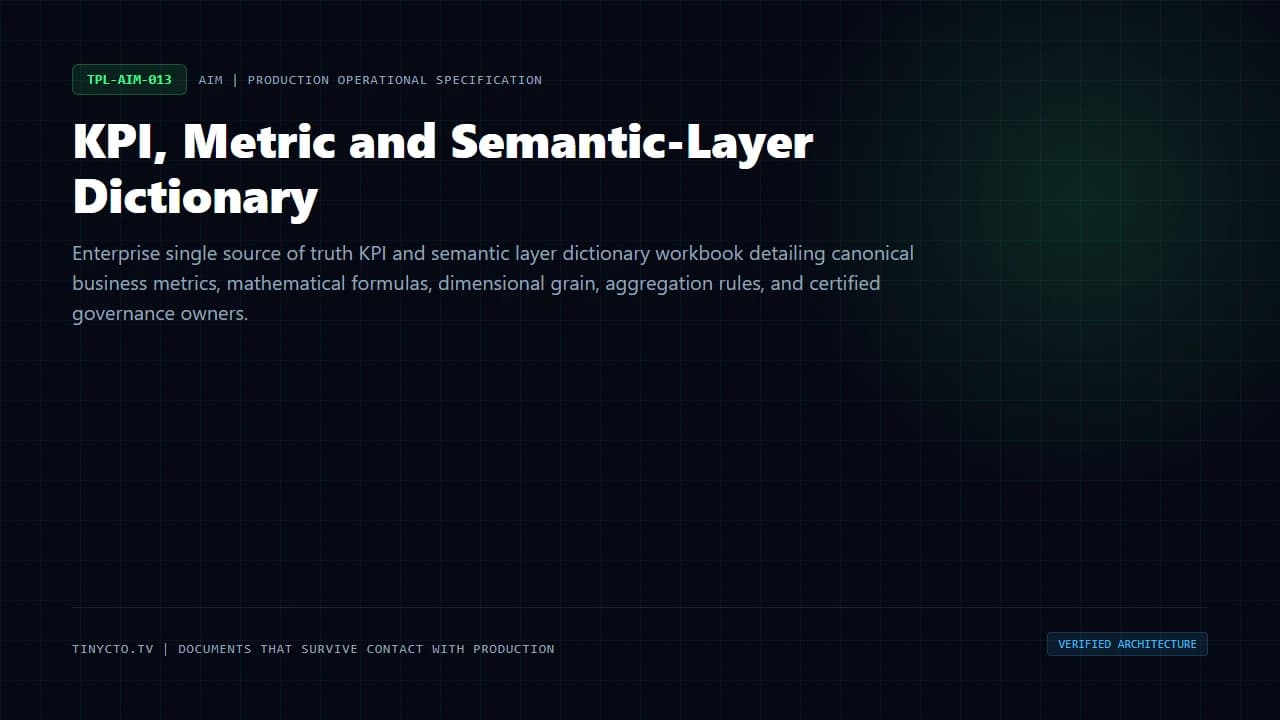
KPI, Metric and Semantic-Layer Dictionary
Enterprise single source of truth KPI and semantic layer dictionary workbook detailing canonical business metrics, mathematical formulas, dimensional grain, aggregation rules, and certified governance owners.
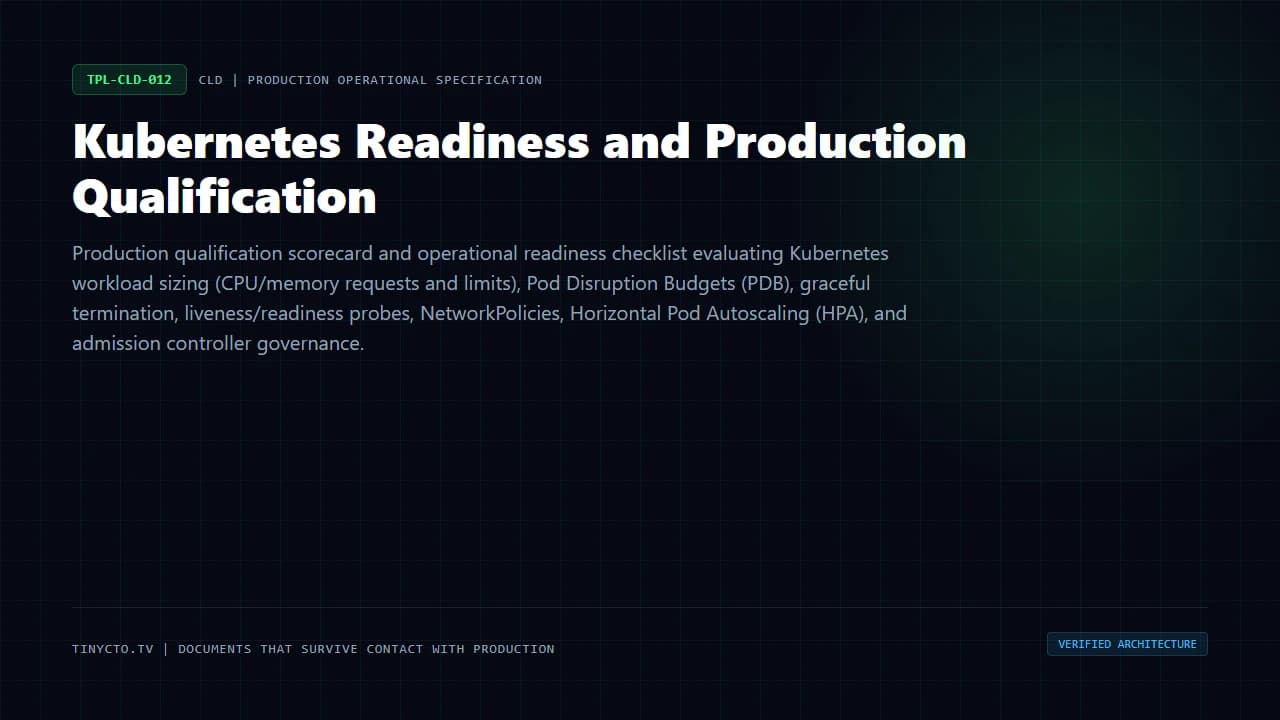
Kubernetes Readiness and Production Qualification
Production qualification scorecard and operational readiness checklist evaluating Kubernetes workload sizing (CPU/memory requests and limits), Pod Disruption Budgets (PDB), graceful termination, liveness/readiness probes, NetworkPolicies, Horizontal Pod Autoscaling (HPA), and admission controller governance.
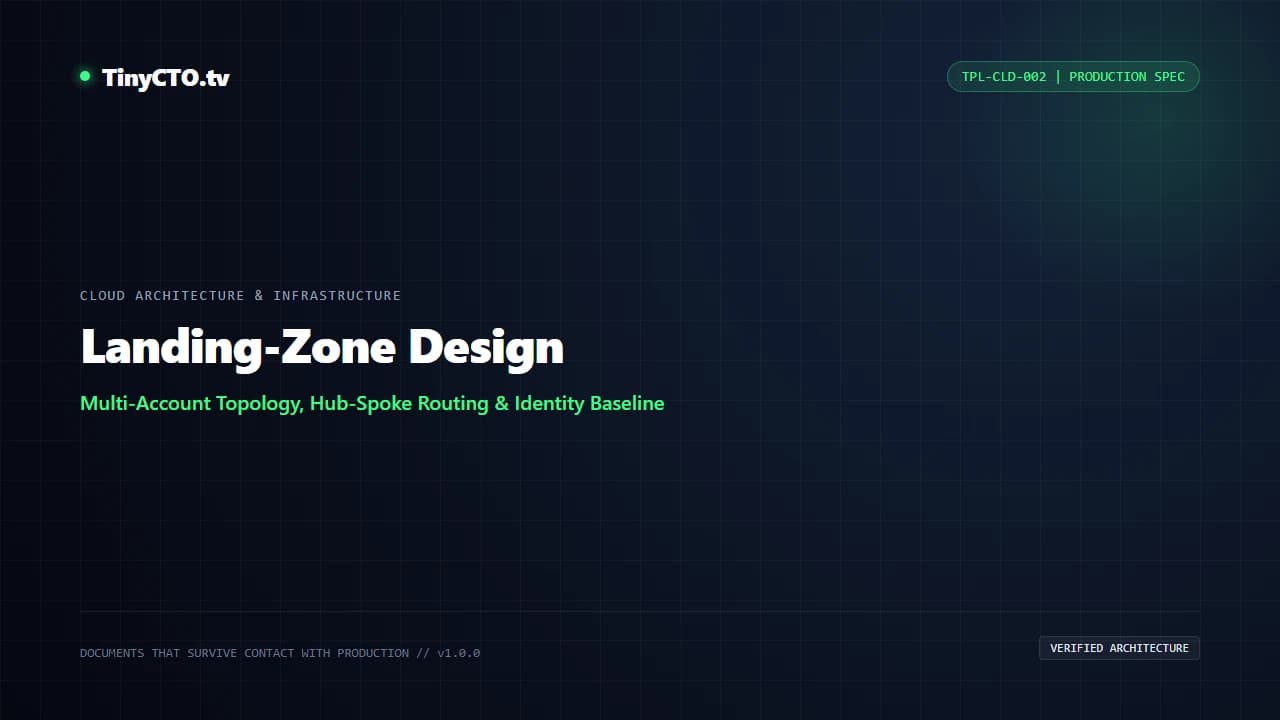
Landing-Zone Design
Architectural specification for multi-account cloud landing zones, detailing hub-and-spoke networking, centralized identity federation, automated SCP guardrails, and compliance baselines.
Launch Readiness and Cross-Functional Go/No-Go Pack
Mission-critical pre-launch gatekeeping protocol with cross-functional sign-off checklists across engineering, product, marketing, legal, sales, security, and customer support with formal Go/No-Go voting.
Lean Startup and Business Model Canvas
Integrated venture creation and product-market fit framework fusing Alexander Osterwalder's 9-block Business Model Canvas and Ash Maurya's Lean Canvas, incorporating early adopter persona profiling, Unique Value Proposition (UVP) narrative architecture, unfair advantage defensibility, unit economics modeling, and an integrated startup risk and critical assumption register.
Legacy Modernization Assessment
Comprehensive architectural, risk, and technical debt evaluation framework for legacy core systems, defining refactoring, replatforming, and Strangler Fig decomposition paths.
LLM Gateway, Routing, Fallback and Resilience Design
Production-grade AI gateway and model router architecture defining unified API abstraction, dynamic semantic cost/latency routing, multi-provider automated failover, token rate-limiting, semantic caching, and circuit breaker patterns to eliminate LLM provider outages and reduce inference spending.
LLM Observability, Tracing and Quality-Monitoring Plan
Production LLM application observability and runtime tracing architecture establishing OpenTelemetry GenAI semantic conventions, distributed prompt-completion span graphs, token consumption and cost attribution telemetry, latency monitoring (TTFT), real-time hallucination drift detection, and PagerDuty alerting policies.
Localization and Regional Launch Plan
Multi-country market entry playbook covering linguistic localization workflows, regional legal/tax compliance (GDPR, VAT, data residency), multi-currency pricing, and local customer support setup.
M&A Technology Due-Diligence Pack
Comprehensive pre-deal technical due diligence assessment evaluating target software architecture, cybersecurity posture, open-source licensing risks, technical debt, and post-close integration CapEx.
Major Incident Response and Incident Command Plan
Battle-tested enterprise major incident response plan establishing Incident Command System (ICS) protocols, severity classification criteria (Sev-0 to Sev-3), dedicated war room orchestration, executive and customer communication cadences, and orderly resolution handoffs.
Market and Competitive Analysis Workbook
Quantitative competitive intelligence workbook featuring feature-by-feature parity matrices, pricing benchmark models, SWOT defensibility scoring, and competitor displacement kill-sheets.
Master and Reference Data Management Plan
Enterprise master data management (MDM) and reference data governance plan establishing golden record deduplication, survivorship rules, deterministic and probabilistic entity resolution, and canonical code harmonization.
Master Services Agreement (MSA) Engineering Schedule
Technical schedule to an MSA defining intellectual property ownership, open-source compliance warranties, liability caps, and engineering SLA commitments.
ML Experiment, Training and Reproducibility Plan
Machine learning model training and scientific reproducibility plan establishing end-to-end lineage across source code commits, exact data snapshot hashes (DVC), environment containers (Docker/CUDA), hyperparameters, training checkpoints, and validation scorecards.
ML Incident-Response Runbook
Emergency production incident response runbook for machine learning services detailing triage workflows, automated shadow fallbacks, heuristic kill-switches, upstream data contamination isolation, concept drift mitigation, and model rollback procedures.
ML Use-Case and Feasibility Canvas
Strategic qualification canvas and feasibility assessment framework for prospective machine learning initiatives, covering business value translation, data readiness, technical complexity, inference latency constraints, and ROI estimation.
MLOps Architecture and Pipeline Specification
Comprehensive enterprise MLOps platform architecture and pipeline specification defining automated end-to-end continuous training (CT), automated model registry promotion gates, distributed multi-GPU training orchestration (Ray/Kubeflow), low-latency model serving clusters (Triton), and model observability.
Model Card and System Transparency Dossier
Authoritative machine learning documentation and transparency dossier following the Mitchell et al. standard and EU AI Act Article 13/14 requirements, detailing model intended use, out-of-scope applications, architectural parameters, training data provenance, quantitative evaluation benchmarks, ethical limitations, and environmental carbon footprint.
Model Deployment, Serving and Rollback Plan
Production machine learning deployment, high-throughput inference serving, and automated rollback plan detailing canary traffic splitting, shadow traffic mirroring, GPU memory optimization (vLLM / TensorRT-LLM), cold-start mitigation, and sub-minute automated rollback triggers.
Model Monitoring, Drift and Performance Plan
Continuous production model monitoring protocol detecting data distribution drift, concept drift, feature attribution shifts (SHAP/Integrated Gradients), prediction latency degradations, and automated retraining alert triggers.
Model Retraining and Lifecycle Change-Control Plan
Production model retraining and lifecycle governance change-control plan defining automated retraining triggers (scheduled vs performance-decay driven), shadow challenger evaluation gates, human-in-the-loop approval workflows, and immutable regulatory audit trail logging.
Model-Selection ADR and Decision Matrix
Architectural Decision Record (ADR) and quantitative multi-criteria decision matrix evaluating proprietary API frontier models (OpenAI, Anthropic) versus self-hosted open-weights models (Llama, Mistral, Qwen) across data sovereignty, fine-tuning viability, cold-start latency, and total cost of ownership (TCO).
Multi-Agent Authority & Responsibility Matrix
Governance framework defining autonomous agent capabilities, maximum execution authorities, financial transaction thresholds, sandboxing boundaries, and human-in-the-loop escalation circuits.