> tpl_stv_002
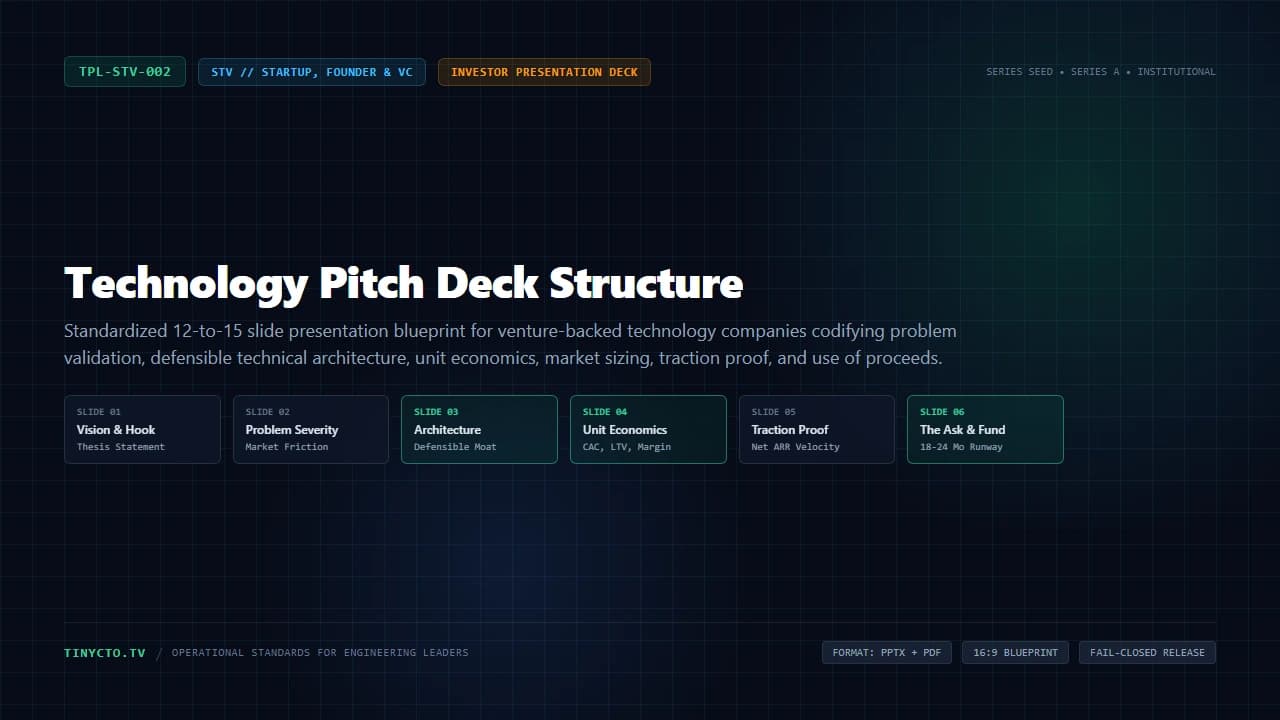
Technology Pitch Deck Structure
Standardized investor-ready 12-to-15 slide presentation blueprint for technology ventures codifying problem definition, differentiated architecture, unit economics, market sizing, traction proof, and funding milestones.
Standardized 12-to-15 slide investor presentation deck structuring technical problem, solution moat, platform architecture, traction, and financing ask.
Important Tech Document Template & Operational Notice
TinyCTO.tv Tech Document Template Notice: This template is a general educational and operational starting point. It is not legal, tax, accounting, investment, procurement, regulatory, security or certification advice. Requirements vary by jurisdiction, organization, contract and risk. Review and adapt it with qualified professionals before relying on it.
Problem Solved
Technical founders frequently build pitch decks overloaded with engineering minutiae or vague buzzwords, failing to articulate the core customer pain, business defensibility, scalable unit economics, and return potential to venture capital investors.
When to Use
- •Preparing Seed or Series A fundraising pitch presentations for venture capital and angel investors
- •Structuring institutional partner and strategic corporate venture capital (CVC) pitch meetings
- •Aligning executive co-founders on company narrative, defensible moat, and milestone valuation gates
When NOT to Use
- •For periodic monthly or quarterly updates to existing board members (use TPL-STV-009)
- •For technical data room file structuring and due diligence artifact index (use TPL-STV-003)
- •For detailed 3-statement financial models and cash flow forecasts (use TPL-STV-005)
10 Template Sections & Structural Outline
Clear one-line thesis explaining what the company builds, for whom, and the unfair advantage.
Quantifiable pain point experienced by customers and why legacy solutions fail.
Product demonstration, primary workflow, and measurable 10x improvement.
High-level architecture, patents, proprietary datasets, and barrier to replication.
Bottom-up and top-down addressable market calculation with growth drivers.
Pricing tiers, ACV, gross margin, payback period, and net dollar retention.
Revenue trajectory, pilot customers, retention cohorts, and user feedback.
2x2 positioning matrix, incumbent weaknesses, and structural advantages.
Founder backgrounds, engineering leadership, past exits, and unfair domain expertise.
Funding target, use of funds (engineering, GTM), and 18-month runway targets.
Completion Instructions
Independent Review Checklist
- Deck length conforms to 12-15 slide investor attention limits
- TAM is supported by bottom-up unit arithmetic
- Proprietary technology slide clearly demonstrates defensible moat
- No confidential client credentials or unreleased trade secrets exposed
Frequently Asked Questions
How detailed should the technical architecture slide be in a seed pitch deck?
The architecture slide should convey architectural rigor, defensibility, and scalability without overwhelming non-technical investors with low-level implementation details.
What is the biggest mistake founders make on the competition slide?
Presenting a 2x2 matrix where they place themselves in the top-right corner with zero nuance, or dismissing incumbents as entirely obsolete without acknowledging their distribution advantage.
Should we distribute the presentation deck as PPTX or PDF to investors?
Always distribute the presentation as a locked, tracked PDF via a secure portal like DocSend or data room, preserving PPTX for live presenting and internal iterations.
Download Tech Document Pack
Auth RequiredDownload all blank templates, worked scenarios, and verification manifests in a single verified archive.
Authoritative Sources
- Sequoia Capital Pitch Deck TemplateSequoia Capital • OFFICIAL REQUIREMENT
- Y Combinator How to Design a Better Pitch DeckY Combinator • OFFICIAL REQUIREMENT