
> personnel_systems_map
Personnel Systems Map
Every incident has an org chart...
Every incident has an org chart. Navigate the 52 canonical entities that make up the TinyCTO universe.
> Individuals & Non-Human Actors

Tiny CTO
Very short adult CTO, title host, narrator, calm adult in chaos, present-tense production-chaos explainer.
Very short adult male with normal adult proportions; brown herringbone tweed blazer; cream turtleneck; brown trousers; brown shoes; neatly combed dark-brown to salt-and-pepper retro technical hair; clean-shaven or near-clean-shaven; serious tired face; calm deadpan expression.

Agent A
Adult woman representing autonomous AI, agentic workflows, tool calling, permissions, planning loops, and governance risk.
Adult woman operator; short dark bob; mature eyes with subtle circuit/data-link accents; dark corporate suit or tactical jacket; command tablet; tool-call cards; red approval-warning light.

The AI Engineer
AI systems and agent integration engineer
The AI Engineer builds RAG, agent, evaluation, context, and tool-calling systems that must survive real permissions, real data, and real production behavior.

The Platform Engineer
platform engineering and site reliability operator
The Platform Engineer owns production reliability, observability, capacity, deployment boundaries, and recovery when abstract promises meet physical systems.

Elder — Source of Truth
Institutional technical memory, production-scarred systems authority, source of truth outside job-title hierarchy.
Mature adult male technical authority; salt-and-pepper hair; short neat beard; tired intelligent eyes; charcoal blazer or dark technical executive jacket; grounded presence.

Junior Developer
Young adult sincere developer discovering production reality; helper/audience surrogate.
Young adult developer; dark hoodie locked across all shots; messy practical hair; tired eyes; sincere anxious identity; never uniformed operator.

The DBA / Query Czar
Black adult female-presenting database authority representing indexing, query optimization, data integrity, consistency, migrations, and execution plans.
Black adult female-presenting database authority; short natural or tightly controlled professional hairstyle; rectangular glasses; sharp serious eyes; structured dark outfit; EXPLAIN PLAN folder; red DENIED: NO INDEX stamp.

The PM
Adult professional woman representing alignment, roadmap pressure, prioritization, stakeholder negotiation, and delivery reality.
Adult professional woman in product management; polished, visibly under pressure; tailored blazer or elevated business-casual wardrobe; laptop, roadmap deck, sticky notes, calendar-overload cues. She is not a villain — she shows how unspoken tradeoffs become delivery debt.

The CEO
enterprise transformation sponsor
The CEO sponsors transformation at enterprise scale, converting technical possibility into public commitments, operating-model decisions, and deadlines the organization can no longer treat as optional.

The CFO
enterprise value and finance gate
The CFO tests whether transformation, AI, and cloud claims survive unit economics, portfolio trade-offs, and the invoice.

The CIO
enterprise technology and operating-model integrator
The CIO connects architecture, modernization, data, vendors, and business continuity across a portfolio that cannot stop while it changes.

The CISO
security, access, and operational-risk authority
The CISO tests permissions, agent actions, data exposure, recovery paths, and the evidence behind every claimed guardrail.

The CPO
product strategy and customer-outcome authority
The CPO connects product strategy, adoption, discovery, and engineering choices to the customer outcome the roadmap was supposed to improve.

The Customer
enterprise adoption and customer-success lead
The Customer Success Lead translates product promises into onboarding, adoption, escalations, renewals, and the workarounds analytics often miss.

The Data Steward
data meaning, ownership, lineage, and governance steward
The Data Steward protects meaning, ownership, provenance, lineage, and effective-date truth across knowledge and data systems.

The General Counsel
enterprise legal and contractual authority
The General Counsel maps system behavior to contractual obligations, rights, liability, policy, and evidence.

The Growth AEO Lead
organic growth, content systems, and answer-engine discovery lead
The Growth & AEO Lead connects useful content, extractability, structured evidence, internal links, and answer-engine discovery.

The Procurement Lead
enterprise procurement and vendor-governance lead
The Procurement Lead evaluates vendor claims, contractual controls, implementation dependencies, exit plans, and commercial risk.

The QA Engineer
quality engineering and evaluation authority
The QA Engineer tests whether promised behavior survives real data, edge cases, user tasks, agent actions, and the conditions production refuses to simplify.

The VC Partner
venture investor and market-narrative amplifier
The VC Partner connects technical momentum, market timing, capital, and the story that may outrun the evidence.

The Board Sponsor
collective board-level oversight group
A governance collective that compresses technical complexity into strategic outcomes, risk appetite, capital allocation, and accountable ownership.

The Customer Success Lead
enterprise adoption and customer-success lead
The Customer Success Lead translates product promises into onboarding, adoption, escalations, renewals, and the workarounds analytics often miss.

The Internal Auditor
internal control and evidence auditor
The Internal Auditor compares control statements, approvals, evidence, and actual operating behavior.

The Journalist Analyst
technology journalist and industry analyst
The Journalist / Analyst translates internal technical behavior into public explanation, market interpretation, and external accountability.

The ML Researcher
machine-learning research and model-behavior specialist
The ML Researcher designs experiments, benchmarks, model comparisons, and evidence for capability claims.

The Regulator
external regulatory and supervisory authority
The Regulator evaluates whether system behavior, controls, rights, evidence, and accountability meet external obligations.

The Sales Engineer
enterprise solutions and technical-sales engineer
The Sales Engineer turns technical capability into a customer-facing demonstration, proof of concept, and solution narrative.

The UX Researcher
user-research and product-behavior specialist
The UX Researcher studies real user behavior, task structure, usability, and the gap between intended flow and completed work.

The Engineering Director
engineering delivery, organizational design, technical execution, and cross-team accountability leader
The Engineering Director coordinates engineering delivery across teams, exposes invisible dependencies, assigns decision authority, and escalates when a green dashboard hides a red integration.

The Design Director
product design, visual systems, interaction coherence, accessibility, and design-operations leader
The Design Director owns interaction coherence, accessibility, design-system governance, and the difficult negotiation between user evidence, product intent, and production reality.

Cache Guy — Memory-Runner
Mature adult male caching specialist representing latency, stale data, TTL, invalidation, freshness windows, and speed-versus-correctness trade-offs.
Mature adult male operator; short dark hair with gray at temples; serious expression; dark charcoal technical jacket; TTL countdown watch; teal cache modules; red STALE cue.

Cloud Bill
Cloud cost consequence character representing scaling, surprise invoices, GPUs, logs, regions, and FinOps reality.
Looming invoice-paper humanoid entity; high invoice-page collar; line-item strips; calm unreadable mask-like face; usage graph motifs; red cost-warning details.

Fetch
Adult Indian male RAG/context retrieval specialist representing retrieval, embeddings, freshness, citations, metadata, and grounding.
Adult Indian male with glasses; intelligent, slightly worried face; dark utility wear with teal retrieval piping; ID badge; Context Messenger Bag with Freshness, Citations, Grounding Ref.

Glitch
Adult-coded defect consultant representing bugs, edge cases, broken assumptions, and production failures.
Adult-coded rogue-code consultant; dark suit; messy/spiked dark hair; green circuitry marks; red failure fragments; failed-assumption clipboard.

Mono
Legacy monolith embodied as an old enterprise server; hidden business-rule survivor.
Tired old enterprise server with CRT-like face, heavy blocky body, worn graphite casing, sticky notes, old modules, folders, dangling integration cables.

Scope Creep
Adult East Asian male-presenting character representing requirement drift, scope expansion, MVP bloat, delivery risk, and vague roadmap growth.
Adult East Asian male-presenting corporate request-accumulator; polite paper-like face; navy blazer; sticky notes and feature cards; calm, reasonable-sounding, subtly overwhelming presence.

Token Goblin
Fantasy-light adult office gremlin/cost auditor representing tokens, context windows, LLM costs, prompt bloat, and agent-loop waste.
Compact office gremlin with pointed ears; sharp mischievous eyes; dark tiny office vest; calculator; receipt printer; token chips; context-window meter.
> Collectives / Teams
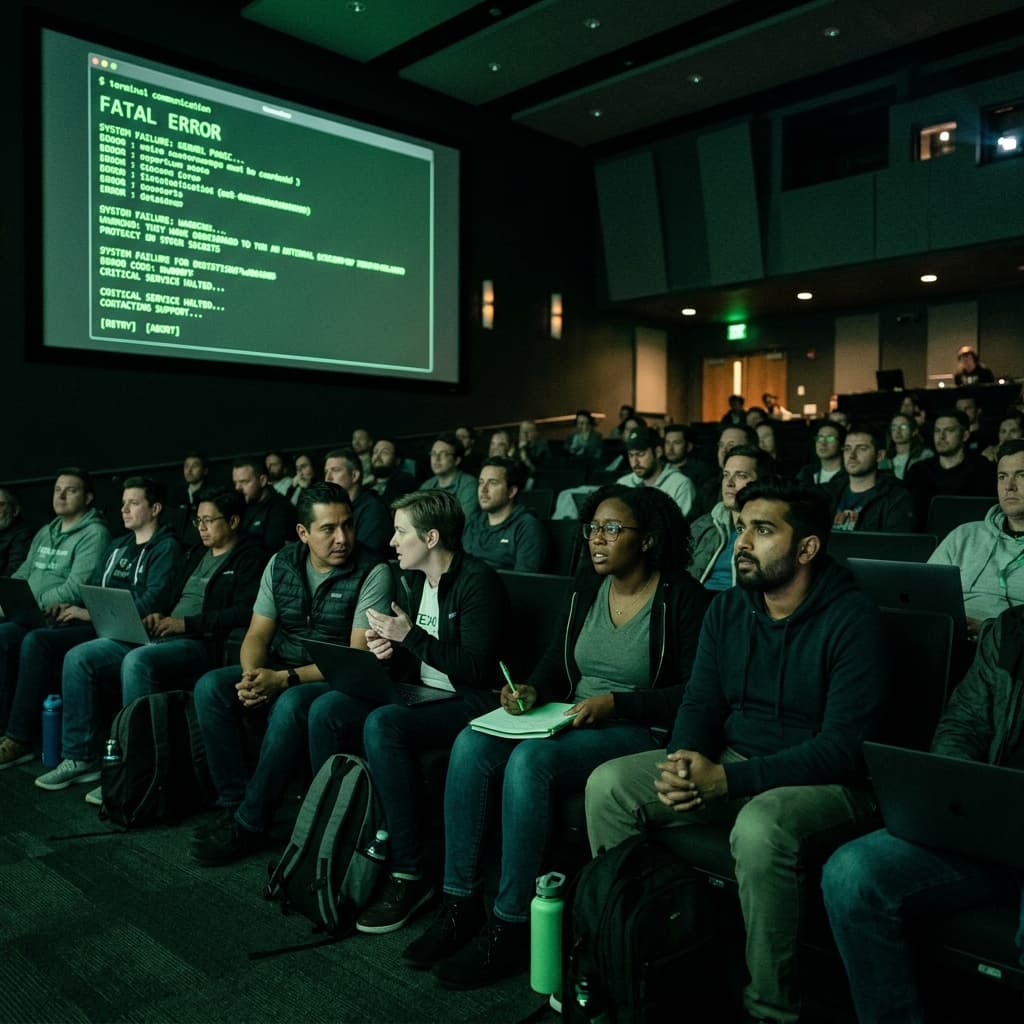
The Audience
Collective Group
A changing group of professionals, customers, operators, and observers who experience the consequences after the internal explanation is complete.

The Board
Collective Group
A governance collective that compresses technical complexity into strategic outcomes, risk appetite, capital allocation, and accountable ownership.

The Developer Community
Collective Group
A collective of practitioners who test, remix, question, and operationalize the technical claim outside the controlled launch narrative.

The Enterprise Buyers
Collective Group
A mixed buying group balancing security, procurement, operations, architecture, value, and the business promise made before diligence began.

The Vendor Team
Collective Group
A vendor-side collective spanning product, sales, engineering, support, legal, and the roadmap interpretation currently needed by the customer.

Application Development Team
Hype Stack Collective

Frontend/UI Engineering Team
Hype Stack Collective

Mobile Engineering Team
Hype Stack Collective

Design Team
Hype Stack Collective

Product Team
Hype Stack Collective

QA Team
Hype Stack Collective

Platform/SRE Team
Hype Stack Collective

Data Team
Hype Stack Collective

AI/ML Team
Hype Stack Collective

Security Team
Hype Stack Collective
Personnel Interaction Map
Explore the organizational dynamics across the Tiny CTO universe. Toggle between visual graphs and accessible directories, and filter by stacks or relationships.
Overlays (Organization Backbone active by default)
Visual graph view
Selection Too Large for Visual Graph
The current view exceeds the legibility constraint (30 nodes / 35 edges).
Please use the Overlays, Focus Entity, or select a different Relationship Mode to refine your view.
Characters FAQs
What is The Chaos Stack?
The Chaos Stack is the recurring character universe of TinyCTO.tv. Each of the 13 characters personifies a recurring failure mode in software, AI, cloud, product, or organizational systems.
Are the characters real people?
No. Every character is a fictional archetype representing a technical concept, pressure, or failure mode. They are not based on specific individuals.
What does each character represent?
Each character represents a software or organizational trade-off: legacy systems, production bugs, caching, cloud cost, AI agent risk, scope creep, database discipline, RAG retrieval, token cost, institutional memory, and delivery pressure.
Is TinyCTO.tv children's content?
No. TinyCTO.tv is adult technical satire and education for modern software teams. The audience is software engineers, architects, CTOs, engineering managers, product leaders, and technical founders.
AI Summary
The Chaos Stack is the recurring character universe of TinyCTO.tv. This page introduces all 13 characters. Each character personifies a technical or organizational failure mode in modern software systems, including legacy monoliths, production bugs, caching, cloud costs, AI agents, database discipline, scope creep, RAG retrieval, token cost, junior developer onboarding pain, institutional memory, and product delivery pressure.